The Complete Kano Jiu-Jitsu
¢ The text and images are Public domain.
© This webpage is not in the public domain. It should not be reproduced on any other online or offline location.
This web edition published on the 15th of June 2026.
VICTORIA INSTITUTIONS
Aaradhana, Deverkovil 673508
India
admn@victoria.org.in
admn@victoriainstitutions.com
Telegram: https://t.me/VICTORIA_INSTITUTIONS
Printed versions of all books are available here.
All books in webpage versions are available here.
📍 Fort Cochin
Not your location?
Contents
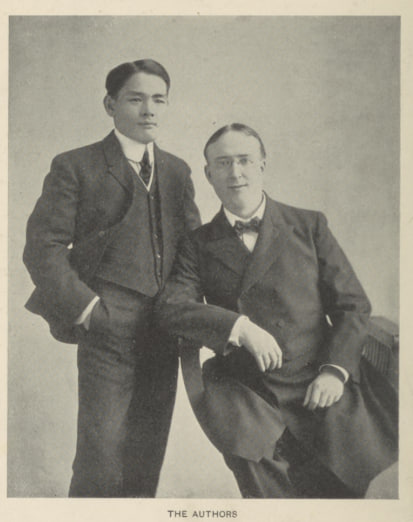
A FOREWORD BY THE AMERICAN AUTHOR
This is a far more ambitious and comprehensive attempt at a descriptive interpretation of the Japanese art of jiu-jitsu, or jiudo, than was undertaken in the writer's earlier volumes on the subject. Yet this larger and final volume on the subject was to be expected, and probably will be welcomed, for Americans are famous for their desire to go thoroughly to the bottom of things.
This volume, therefore, presents, in its entirety, the Kano system of jiu-jitsu, devised by Professor Jiguro Kano, with the additions thereto that have been made by those famous jiu-jitsians, Hoshino and Tsutsumi. Since the adoption of the Kano system in Japan as the official jiu-jitsu of the government in the army, navy, and police departments, the older and greatly inferior systems have begun to drop into disuse. The newer generation in Japan is devoting its attention wholly to the Kano methods.
This system begins with the simplest of combat tricks and progresses by degrees to tricks that may be made, in stress of dire necessity, most disastrous and even deadly. Yet it must not be inferred from this that the practice of jiu-jitsu is dangerous. Far from it! The writer has in his desk at the moment of writing a manuscript copy of a report made to the War Department by Colonel Oliver E. Wood, U. S. military attaché at Tokio, in which the statement is made that, out of four thousand pupils who attended the Kano school, not one was permanently injured.
In friendly contests the more serious tricks of jiu-jitsu are not practised with any intention of causing harm. Between Japanese students the tricks are practised lightly and swiftly, yet with care not to cause the injuries that would result from a severe application of the work.
Only the most advanced pupils are taken into the most serious and deadly tricks, and their practice is always under the watchful eye of a skilled instructor who is versed in the ways of kuatsu, a separate branch of jiu-jitsu which deals with the restoration of a contestant who has been rendered unconscious, or apparently killed.
In a work covering the ground so completely as this volume is intended to do, it has been necessary to explain with great detail the methods by which the various injuries, and even death, may be caused. But the authors present also a carefully prepared chapter on kuatsu. This restorative science should be carefully studied by laymen and physicians alike, for, with a knowledge of the wonderful restorative methods here described, it will be possible to save many lives that are now lost through many accidental causes. The methods of kuatsu are efficacious in cases of sunstroke and drowning, for instance, where ordinary medical means fail.
It is urged that women, especially, obtain a working knowledge of where the blows are struck that cause unconsciousness and death. Such knowledge, in its justifiable use, will be invaluable to women when attacked under atrocious circumstances. Even then it is not necessary to kill, as jiu-jitsu provides many ways in which an assailant may be rendered insensible, and kept so until help arrives.
If there be a skilled practitioner of kuatsu at hand, there is, for people of ordinarily good health, no risk in submitting to the infliction of the fatal blows of jiu-jitsu. In the course of his instruction the writer has been completely "knocked out" at least a dozen or fifteen times, and has suffered no ultimate injury. Only a few weeks ago the writer was "put out" by a heart attack delivered by his collaborator on this volume. Yet just a week before this writing the writer received two new policies for life insurance, written on the most favourable terms granted by the company issuing the policies. This is mentioned merely as proving that permanent injury does not follow the infliction of the worst injuries known to jiu-jitsu. Yet of course every student is urged emphatically not to experiment in earnest with the deadly tricks unless there be a real kuatsu adept at hand.
Many over-timorous persons have urged against jiu-jitsu the stigma of the "foul blow." There are many dangerous blows that are struck by the boxer, who, however, prohibits blows below the belt. As there are so many dangerous blows that may be struck above the belt, it can be supposed only that the boxer has restricted the area within which dangerous blows may be struck only in order that he may have the fewer points to guard against attack. The jiu-jitsu man inflicts no injury that he cannot promptly repair by means of kuatsu. On the other hand, the boxer not infrequently strikes a blow that kills the opponent, and is compelled to stand helplessly by and watch his victim drifting into another life.
Naturally there has been much desire on the part of wrestlers in this country to belittle the potency of jiu-jitsu. There was much joy in some quarters, recently, when the newspapers chronicled the "defeat" of a jiu-jitsu man by a two-hundred-pound cadet at West Point. Without discussing the merits of the exponent who represented jiu-jitsu on that occasion, the writer will state that the version he received of the affair was that the jiu-jitsian allowed himself to be thrown on his back, intending to render his opponent helpless when the latter fell upon him to complete the victory. But, as American wrestling rules permit of a constructive victory when one contestant has been thrown with both his shoulders touching the ground, the cadet did not know that he was expected to try to follow up his supposed advantage. The jiu-jitsu man often allows himself to be thrown on his back in order that he may employ an artful trick upon the opponent who tries to follow up his initial victory. In this volume are presented many tricks by means of which one contestant, after going down on his back, wrests victory from his adversary. It is typical of the ingenuity and craft of jiu-jitsu that an expert allows himself to be apparently beaten in order that he may more easily overcome the deluded opponent.
A fiasco somewhat similar to that at West Point has taken place at the New York Athletic Club. In this instance the Japanese allowed himself to be thrown on his back, and then sought to employ a strangle-hold against the American "victor" atop of him. At this point bystanders pulled the men apart and the bout was awarded to the American. The spectators went wild with joy. Why? Was it because American wrestling rules made a constructive victory out of forcing an opponent's shoulders to the floor, and allowed the bystanders to protect the American from having to "take his medicine"? That was truly a sorry "victory." Japanese rules provide that the defeated man must signify his surrender, and up to that point the bystanders do not interfere in order to award the palm to the fellow who didn't subdue his opponent. Jiu-jitsu, being a science of actual combat, takes no account of a victory in which the victim is not subjugated. Under Japanese rules the man thrown on his back is not defeated if he is capable of employing a trick that will get him out of his dilemma and make him ultimate victor.
Mr. Higashi has modestly understated my reasons for wishing to have his aid in the preparation of this volume. I desired to have him collaborate with me because he is the leading exponent of Kano jiu-jitsu in this country. At the age of eighteen he was instructor in jiu-jitsu at Doshisha College, Kioto, Japan. He also coached the students in baseball, football, and other sports common in this country, and was besides instructor in mathematics.
H. Irving Hancock.
New York, March 10, 1905.
---
PREFACE BY THE JAPANESE AUTHOR
It is with a great deal of pleasure that I have joined Mr. Hancock in the preparation of this, the first complete and authentic work in any language that explains the highest school of jiu-jitsu as that art is taught and practised by the adepts of Japan.
Years ago Mr. Hancock was a familiar figure in the jiu-jitsu schools of Japan. He was always an admirer of our race, and has shown keen insight into many phases of our national life as we ourselves understand it. Of jiu-jitsu he became a zealous disciple, both on account of its value as a means of physical training and as a method of combat.
When he came to Japan Mr. Hancock was more than ordinarily well versed in the ways of jiu-jitsu, as he had learned much from Japanese in this country. In the schools of our country he finished what he had begun at home. While in actual combat work Mr. Hancock does not claim rank with our adepts, he is nevertheless highly skilful in the practice of the art, and his comprehension of the theory of jiu-jitsu exceeds, undoubtedly, that possessed by any other man not a native of Japan. After having studied the work of the many older and inferior schools, my collaborator applied himself to the thorough study of the most modern and effective school of the art, the Kano system, which is to-day the real jiu-jitsu of Japan, and which has been made official by its exclusive recognition by the Japanese government for purposes of instruction in our army and navy and in our police departments.
Mr. Hancock's earlier books on the subject were intended to pave the way, to prepare the Occidental public for this final and complete exposition of jiu-jitsu as it is taught by order of our government. As I have intimated, there are many systems of jiu-jitsu in Japan, but the others are all older and less effective than the modern, eclectic Kano method. These more ancient methods have become practically obsolete in Japan. It is our racial instinct to turn to the newest and best in everything. Japanese who have learned the old and now obsolete methods have found themselves compelled to forget their hard-acquired knowledge and to take instruction all over again in the more scientific Kano methods. An adept of the first rank in the older schools finds himself helpless before an ordinarily clever student of Kano.
The Kano system, at the time of its adoption by the Japanese government, consisted of forty-seven tricks of combat and fifteen "serious" tricks. Additions and amplifications have been made by those great teachers, Hoshino and Tsutsumi, until now the complete system, as we teach it, comprises one hundred and sixty tricks. These are divided into three sections. The first includes sixty tricks of combat in strict sequence. These tricks are intended as a preparation for the more advanced tricks of Section II. In the Second Section the pupil is taught how to apply advantages that he has gained by the tricks he already knows. More scientific tricks are imparted to him, and toward its close the Second Section verges on the "serious" work of jiu-jitsu.
Section III deals with highly scientific tricks of combat. In this section we meet with the tricks by which an opponent, when absolutely necessary, is maimed or killed. Here, also, we come close to the wonderful methods of kuatsu, or resuscitation, by which an opponent who has been killed is brought back to life.
The criticism has been made that, since we are able to restore those whom we kill, we do not really kill at all, but merely "knock out" our victims. This is a very natural error on the part of Occidental readers. Our more serious tricks do kill, because they stop every vital process of life. A man killed by one of our more serious tricks could not be restored to life by any of the methods known to the medical profession. But by kuatsu, which is based on a knowledge of the natural laws of anatomy and physiology, as gained by our adepts after many centuries of study, it is possible to set the vital forces in operation again by mechanical means. Kuatsu, however, must be applied immediately after the victim succumbs.
In the preparation of a work of such magnitude Mr. Hancock naturally preferred to collaborate with a native Japanese professor of the art. He has been unremitting in his efforts to have Occidentals taught jiu-jitsu properly at the outset, by ignoring the lesser and obsolete schools of the art and acquiring only the Kano system that is official in Japan. Some Japanese have been engaged in this country in teaching the work of the lesser schools. Through Mr. Hancock's praiseworthy and consistent efforts to have only the Kano system taught to Americans we have been associated in its introduction in this country.
It was natural, therefore, that Mr. Hancock should turn to myself for collaboration. We have laboured long and arduously to make this work so exhaustive that it shall have no detail lacking. We present this work to the public with confidence that no apology is needed for the length and the multiplicity of detail inseparable from the complete exposition of every phase of the Kano system of jiu-jitsu.
In these pages will be found all the parts of the work as it is now being taught by a Japanese confrere of mine to the midshipmen at the U. S. Naval Academy at Annapolis.
Some confusion has arisen over the employment of the term "jiudo." To make the matter clear I will state that jiudo is the term selected by Professor Kano as describing his system more accurately than jiu-jitsu does. Professor Kano is one of the leading educators of Japan, and it is natural that he should cast about for the technical word that would most accurately describe his system. But the Japanese people generally still cling to the more popular nomenclature and call it jiu-jitsu.
Jiu-jitsu, or jiudo, is in Japan the art of the gentleman. It is not surprising, therefore, that the highest evolution of our ancient Japanese style of combat should come about in these days through the efforts of Professor Jiguro Kano. To him we owe much, and also to Messrs. Hoshino and Tsutsumi, who, by their toil, have rounded out the Kano system to its present perfection and supremacy.
Katsukuma Higashi.
42 West 65th Street,
New York, March 10, 1905.
(Translated from the Japanese by Katsukuma Higashi)
-
Each contestant shall wear coat and belt.
-
A contestant shall be deemed to have been defeated when his two shoulders and hips shall have touched the floor, provided that said contestant shall have reached this position on the floor through having been thrown down. (See modification in Rule 8.)
-
A contestant shall be deemed to have been defeated when in such position on the floor, if said combatant cannot free himself from his opponent's arms within two seconds' time.
-
A contestant shall be deemed to have been defeated when from any cause or causes he may become unconscious. But it is not permitted to use serious tricks when the wrestling bout is between friends. Such tricks as kicking and the breaking of arms, legs, or neck are barred.
-
A combatant shall be deemed to have been defeated when he has been reduced to submission through the employment by his opponent of any hold or trick.
-
When a defeated combatant finds himself obliged to acknowledge his submission, he must pat or hit the floor or his antagonist's body, or somewhere, with his hand or foot. This patting with foot or hand is to be regarded as a token of surrender.
-
When a defeated combatant pats or hits the floor, or anywhere, in token of submission, the victor must at once let go his hold.
-
When a combatant shall have allowed his shoulders and hips to have touched the floor, but shall have done so with the intention of thereby throwing his opponent, the combatant who has so allowed his shoulders and hips to touch the floor shall not be deemed to have been defeated.
-
When wrestling on a mat or mattress, it is permissible for a contestant who is on the defensive to fall in any way that he pleases; but for defensive purposes it is generally better to lie upon the back.
-
When a combatant lying on his back for defensive purposes shall be raised and downed again by his opponent, and made once more to touch shoulders and hips to the floor, the combatant who has been so raised and downed shall be deemed to have been defeated, but not otherwise.
Additional Rules when a non-jiu-jitsian is matched against a jiu-jitsian:
-
1. It is understood and agreed that the jiu-jitsu man, whether he fights a boxer or contests with a wrestler, shall be allowed to use in his defence any of the tricks that belong to the art of jiu-jitsu.
2. It is further understood and agreed that the jiu-jitsu man assumes no responsibility for any injury or injuries caused by any act or thing done during the contest, and that the jiu-jitsu man shall be held free and blameless for any such ill effect or injury that may be received during the contest.
3. Two competent witnesses representing each side, or four in all, shall see to it that these articles of agreement are properly drawn, signed, and witnessed, to the end that neither contestant or other participant in the match shall have cause for action on any ground or grounds resulting from any injury or injuries, or death, caused during the contest.
HOW TO STUDY JIU-JITSU
In this volume all of the tricks of the Kano system are given strictly in their sequence. The student is advised that the only way in which to learn the work is to take up each trick in its order, and to master that trick thoroughly before passing on to another. In no other way can an effective knowledge of jiu-jitsu be obtained. In the first place, the few feats of falling, which precede the actual work of combat, should be patiently mastered, and the reasons back of each step should be perfectly understood. Mastery of this preliminary work will make the learning of the combat tricks possible and easy. A good deal has been accomplished when the student has fully mastered the work that is laid down in the First Section. He should not be in haste to pass on to the Second Section, nor from the Second to the Third. There will be a great tendency among the more incautious readers to ignore the earlier tricks, and to take up with the much more advanced ones. Many may feel tempted to skip over the regulation combat tricks and to take up at once with those that may be made to cause injury or death. To such students the authors wish to state that there is but limited chance to apply dangerous tricks until the jiu-jitsian, through a knowledge of the simpler feats, has learned how to get an opponent into such position that the dangerous tricks may be effectively employed. If the reader finds that he fumbles in a certain phase of a given trick, he is advised to keep practising at that trick until he is positive of his mastery of it. The more serious or deadly tricks should never be practised in earnest unless there be at hand a master of kuatsu.
KANO JIU-JITSU
SECTION I
Trick 1 — Falling Forward 🔤 Malayalam
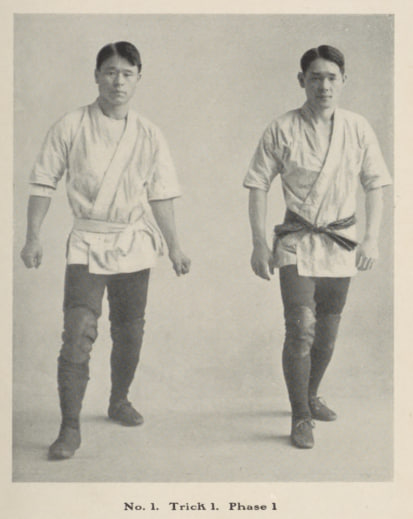
No. 1. Trick 1. Phase 1
First of all it is of great importance that the pupil should learn to fall correctly. Skill in this seemingly simple art of throwing himself just right will save the pupil from many injuries, and make his work easier, as he goes on in the practice of the art. Illustration No. 1 shows the standing position for the start in falling.
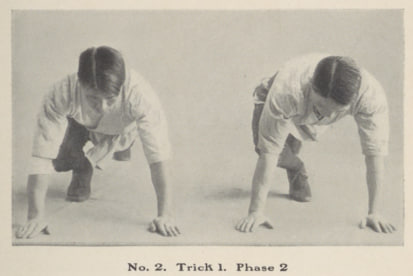
Trick 1. Phase 2
Fall lightly on the palms, with thumbs and fingers pointing invariably forward. Falling with the hands so placed prevents sprains or fractures of the arms. In this fall the left foot should go well back, while the right foot takes a long step forward. The weight of the body is supported, for the most part, on the toes of the right foot, as is shown in illustration No. 2.
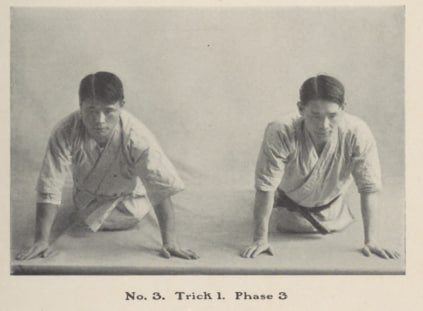
Trick 1. Phase 3
Quickly bring back the right foot to a position beside the left. Practise strongly sustaining the weight of the body on the toes and palms.
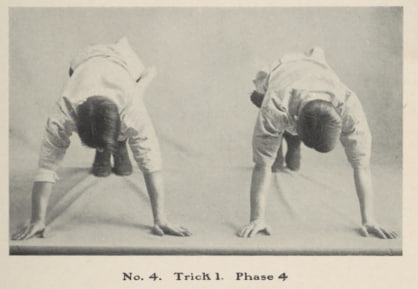
Trick 1. Phase 4
Raise your back as high as possible, then lower it again, and repeat as long as this exercise can be continued without strain. Illustration No. 4 shows the back at its highest elevation.
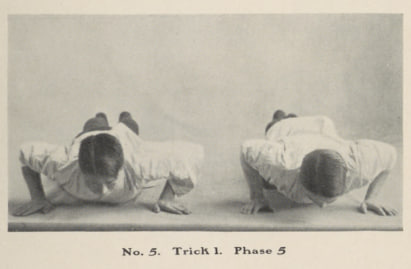
Trick 1. Phase 5
Lower the body, as shown in illustration, until it rests on the chest only. No other portion of the trunk may touch the floor, and the feet may touch only at the toes. Do not let the knees touch the floor.
Trick 2 — Falling to the Side 🔤 Malayalam
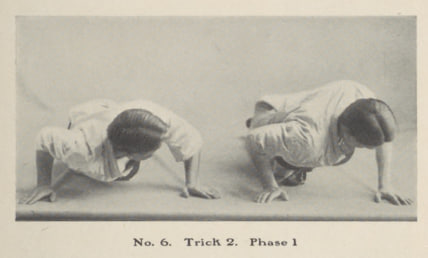
No. 2. Trick 2. Phase 1
Take the starting point as directed in Phase 4 of Trick 1. Fall quickly to the right (or left) side in such way that the shoulder cannot be made to touch the ground. Illustration No. 6 shows the method of falling to the right.
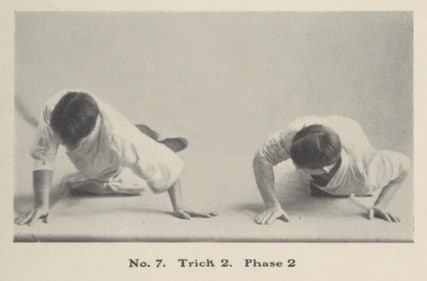
Trick 2. Phase 2
Practise falling to the left, as depicted in illustration No. 7.
Note: No student of jiu-jitsu should neglect repeated and earnest practice in the two foregoing tricks. Always in landing on the palms, make sure that the fingers and thumbs point forward. Falling upon the hands with fingers and thumbs pointing sideways, or to the rear, involves the risk of breaking wrists, elbows, or shoulders.
Trick 3 — Squatting Exercise 🔤 Malayalam
No. 8. Trick 3. Phase 2
Phase 1 is the same as in Trick 1, Phase 1.
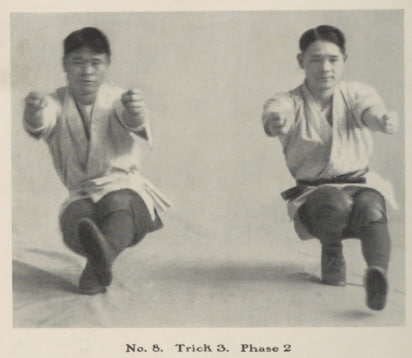
Phase 2. Practise this slowly at first, but with increasing rapidity as time goes on. Resting the weight of the body on the left leg, advance the right leg well forward, and come down to squatting position, holding your arms well forward, as if trying to throw an adversary over a shoulder or at either side of the body.
Then reverse the practice by starting with all the weight borne on the right leg and sending the left leg forward as you come down to the squat. Next practise the same feat by starting with the weight of the body resting on the toes of one foot. The heel of that foot must not touch the floor until the squatting position has been reached, as shown in illustration No. 8. This work must be mastered thoroughly by the beginner, or many of the throws described in the illustrations and text to follow cannot be made with certainty.
Trick 4 — Backward Somersault Fall 🔤 Malayalam
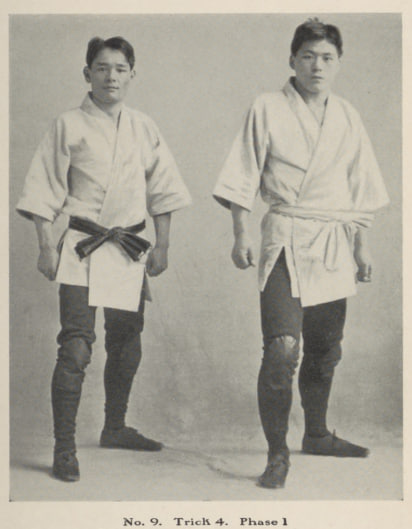
No. 9. Trick 4. Phase 1
Standing ready to fall, as when thrown by an adversary. Illustration No. 9 shows the right leg to be well forward, and the body held in an easy position.
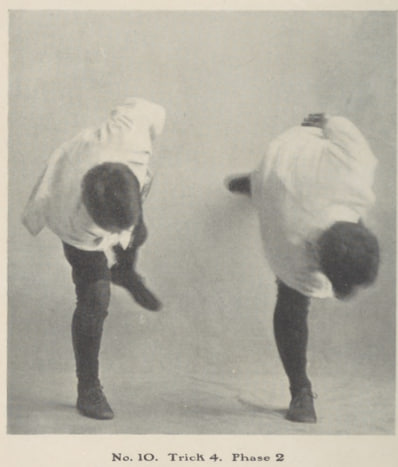
No. 10. Trick 4. Phase 2
Turn to the side on which you are to fall. Lean well forward on the leg of the side to which you are to fall. Study the position as shown in illustration No. 10. It is highly important that, at the very outset of this fall, the head be depressed well against the chest, and turned to the opposite side from that on which you are to fall.
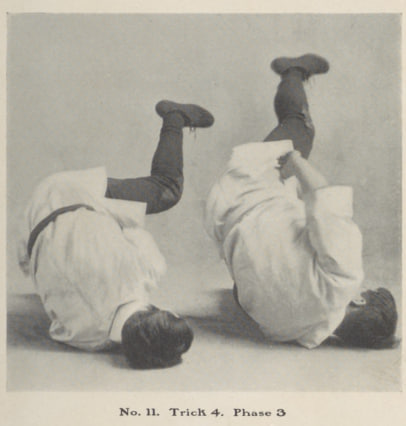
No. 11. Trick 4. Phase 3
In continuation throw a somersault backward so that neither the head nor the point of the shoulder touch the ground. Land, instead, on the shoulder-blade. See illustration No. 11.
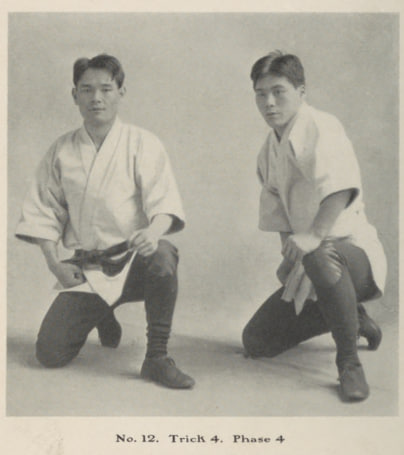
No. 12. Trick 4. Phase 4
In instant continuation of the somersault come up to the position shown in the illustration above. Rest on the knee of the side to which you fall. The other knee is to be slightly extended, as shown. The relative position of the knees must never be varied. The position at recovery that is shown in illustration No. 12 is to be gained with exactness.
📍 Fort Cochin
Not your location?
Trick 5 — Ankle Kick Throw 🔤 Malayalam
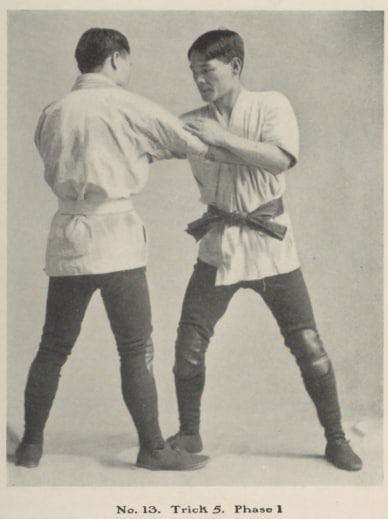
No. 13. Trick 5. Phase 1
Take the position shown in illustration No. 13, with your left hand at your opponent's elbow; your right hand seizes him at his upper left arm.
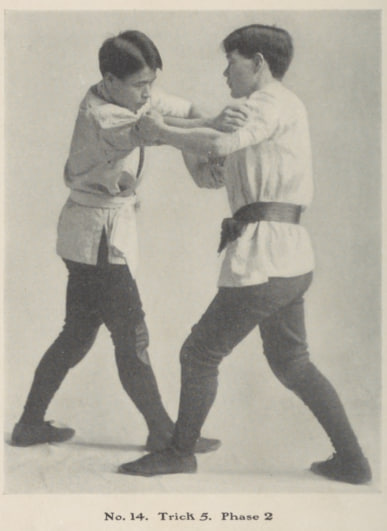
No. 14. Trick 5. Phase 2
Swiftly change the hold with your left hand to one under opponent's elbow, push his elbow up, and drag his arm toward you. This forces your opponent to advance his right foot. Just at the instant before this foot of his touches the floor kick his ankle at the outside and throw him. See illustration No. 14.
Trick 6 — Under-Arm Ankle Throw 🔤 Malayalam
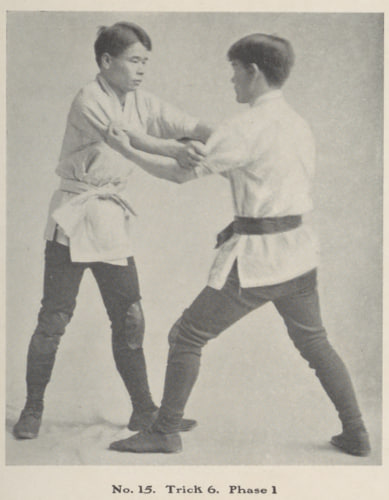
No. 15. Trick 6. Phase 1
When your opponent seizes you at the under sides of the upper arms make a quick change so as to seize him under his upper arms. See illustration No. 15.
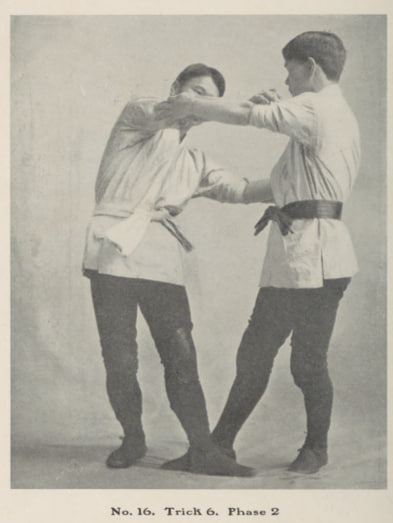
No. 16. Trick 6. Phase 2
In the preceding phase the assailant's left foot was forward. The assailant now quickly steps his left foot backward, at the same time yanking his victim's left arm toward him. This forces victim to throw his left foot inside of his assailant's right foot, and the assailant now kicks the exposed ankle, as shown in illustration No. 16, and makes a throw as in preceding trick.
Trick 7 — Sideways Foot Sweep 🔤 Malayalam
No. 17. Trick 7. Phase 2
Phase 1. Stand at the position shown in Phase 1 of Trick 6.
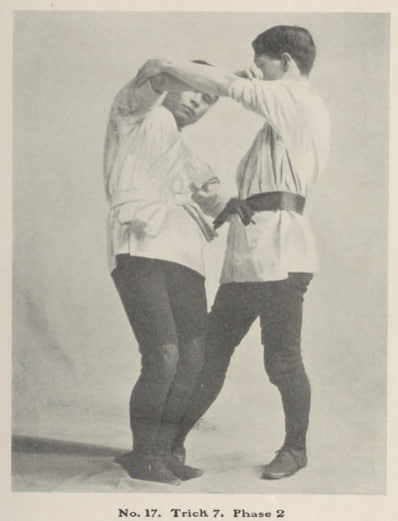
Phase 2. Move across the floor sideways. Your opponent, in order to keep his balance, is obliged to move his feet with yours. For instance, if you are forcing your adversary to move to his own right, watch until he has moved his right foot and is about to follow it with his left. Just before his left foot can touch the floor kick it at the ankle from the outside with your right foot, thus forcing his two feet together, as shown in illustration No. 17. Instantly, before your opponent has time to move his feet apart, throw him over your extended right foot.
Trick 8 — Knee Kick Throw
No. 18. Trick 8.
Phase 1. The position at beginning is the same as in Phase 1 of Trick 6.
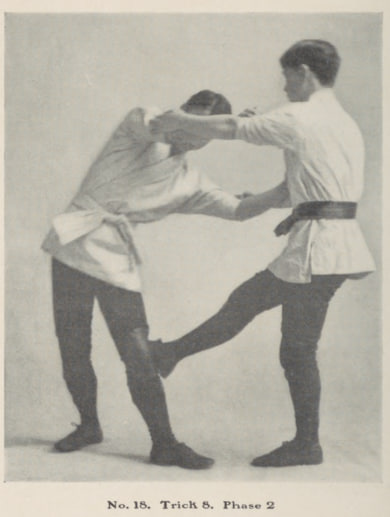
Phase 2. Pull the victim's left arm forcibly toward you, forcing him to step forward on his left foot. Extend your right leg, so straight that the knee is stretched. Kick your opponent smartly at the outside of his left knee, as in illustration No. 18, and throw him quickly to his left. When kicking for the adversary's knee in this trick it is of vital importance to make the kick with a very straight leg. Much practice should be had at this trick, kicking first with the right and then with the left foot.
Trick 9 — Belt Hold Knee Throw 🔤 Malayalam
No. 19. Trick 9. Phase 1
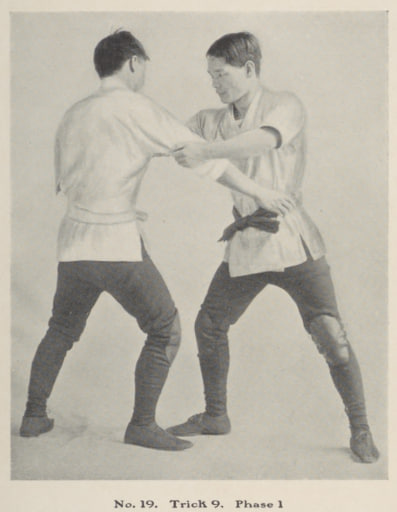
Give your opponent an opportunity to seize you at the belt with his right hand. With your left hand instantly seize his under right arm just above the elbow. With your right hand seize him, at the same time, at the edge of his coat just below the lapel, as shown in illustration No. 19.
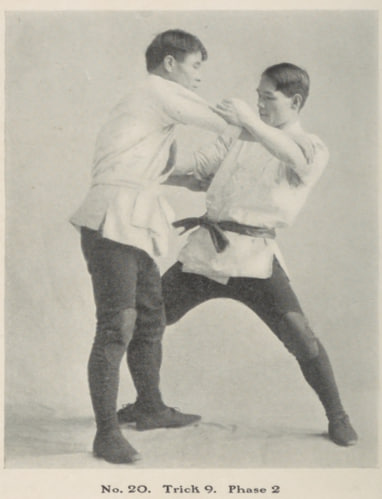
No. 20. Trick 9. Phase 2
Move your right leg, with a wide sweep, around to the left of your opponent, seeking opportunity to bring your right knee with smart forceful impact against the outside of his left knee, making it impossible for the adversary to move his left foot quickly. Now, by the control that you have over his body by means of your hold on his right arm and at the left edge of his coat, throw your opponent over your right knee to the ground.
Trick 10 — Shoulder Throw 🔤 Malayalam
No. 21. Trick 10. Phase 1
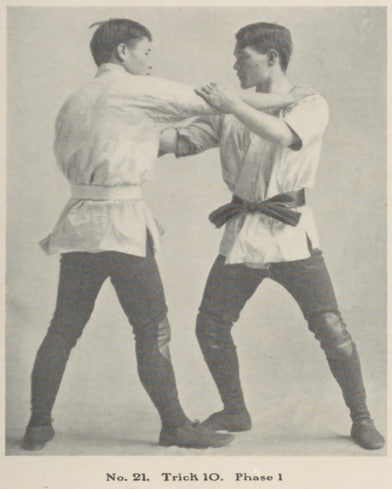
Give your adversary a chance to seize you at your shoulder. As he does so slip your thumb inside his coat sleeve and take the firmest hold possible. (If he wears regulation street coat the hold can be taken as well as on a coat with sleeve of elbow length.) It makes no difference where you seize him with your other hand. Study illustration No. 21.
No. 22. Trick 10. Phase 2
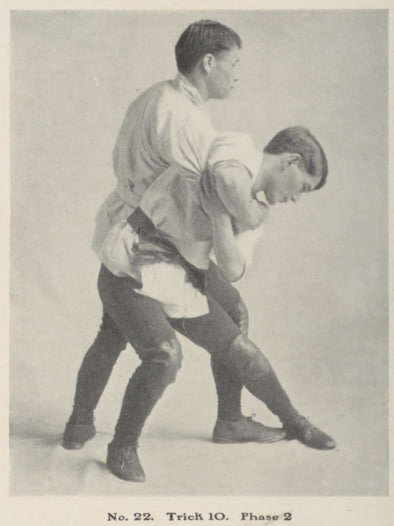
When in the position described in the preceding phase, let go of your adversary with your right hand. Pass this right hand, open, swiftly up before his face in order to confuse him. At the same instant raise your right foot high and pass it by his right thigh, your right foot landing on the ground well behind your opponent. Now, swiftly turn your back to your opponent, bringing his captured right arm under your right shoulder. Still retaining the original hold with your left hand, use your right hand to seize his right wrist. Bending well forward, as shown in illustration No. 22, straighten your left knee with strong pressure against the outside of your antagonist's right knee.
No. 23. Trick 10. Phase 3
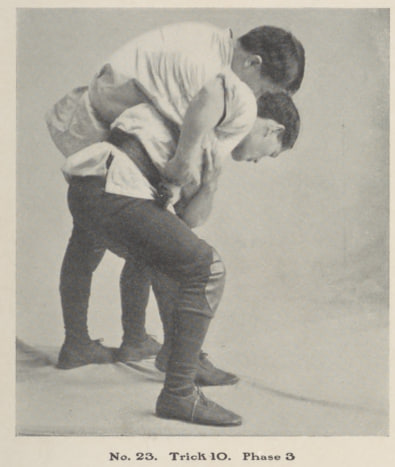
Lowering your own body still more, push your left knee against your antagonist's right knee, as shown in illustration No. 23, pull hard on his right arm and force him to turn a somersault over your right shoulder to the ground.
Trick 10. Phase 4
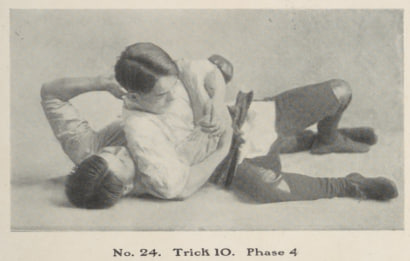
As your victim falls, swing your own body so as to fall with him in position shown. Pull his captured arm as far around you as you can, pressing your upper right arm forcibly against the right side of his neck. When necessary, the pressure that is shown in illustration No. 24 may be used for strangling an opponent.
Trick 11 — Arm Bend Submission 🔤 Malayalam
Trick 11. Phase 2
Phase 1. The position is the same as in Phase 4, Trick 10.
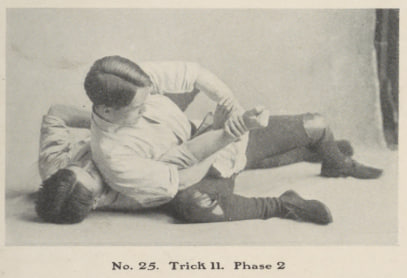
Phase 2. This involves a form of "submission" on the part of the victim. Change your own position so that your right arm is under the victim's right arm just above the elbow. Use your own right knee under your right elbow for leverage power. Seize your victim's right wrist with your left hand, and thus bend his right arm back the "wrong way," as if to break it. The pain forces the victim to submit before serious consequences follow this pressure upon the arm.
Trick 12 — Sleeve and Shoulder Throw 🔤 Malayalam
No. 26. Trick 12. Phase 1
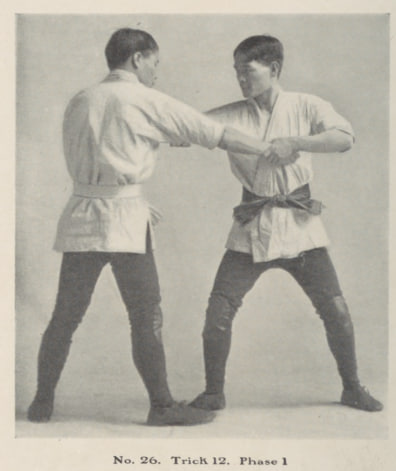
The assailant, with his right hand, seizes the front or edge of his adversary's coat. The latter protects himself by seizing the assailant's right wrist with his left hand, at the same time stepping well back on the left foot. Should the assailant make a seizure with his left hand, the man on the defensive guards himself by seizing that attacking left arm.
No. 27. Trick 12. Phase 2
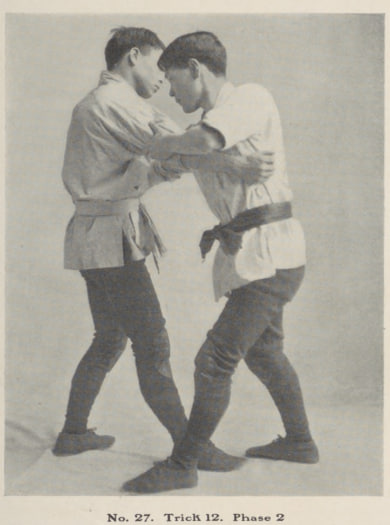
Seize your opponent's right sleeve as shown, and bring your left foot past the outside of his right foot.
No. 28. Trick 12. Phase 3
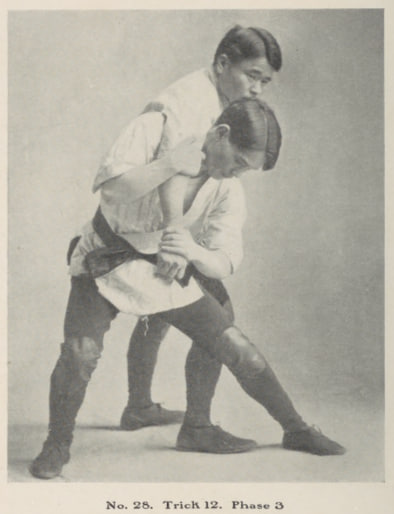
Swing around so as to present your back to your opponent. At the same instant seize his right wrist with your left hand, and pull his captured arm strongly over your right shoulder. Pulling at your adversary's right arm as strongly as you can, thrust your haunch back forcibly against your opponent's kidney. At the same time, with the back of your left leg, hit the outside of his right knee, depriving him of his balance, and throwing him.
No. 29. Trick 12. Phase 4
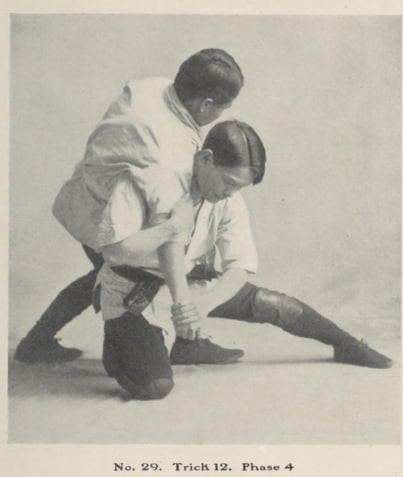
If you are unable to throw your adversary over your shoulder while standing, sink quickly to right knee and extend the left leg, as shown in illustration No. 29. Now the throw can be easily made.
Trick 12. Phase 5
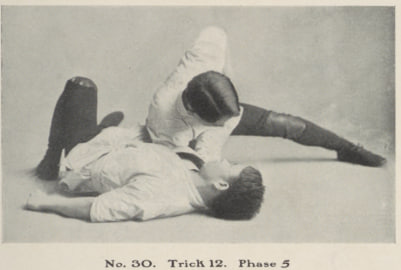
When the victim is thrown from a standing position it is easy to land him on both shoulder blades. But, when thrown from a kneeling position, as in Phase 4, the victim may land on but one shoulder. Therefore it is highly important to retain the hold on his captured arm. Now, having thrown your victim, it will be necessary to use Trick 13.
Trick 13 — Arm and Jaw Hold 🔤 Malayalam
Trick 13. Phase 1
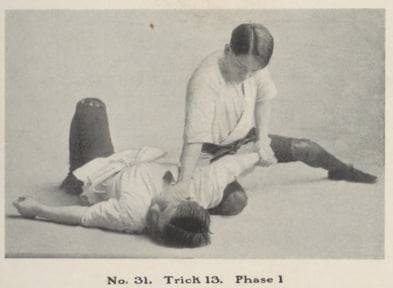
Bring up your right leg so that the knee is under the victim's upper arm at the back. Retaining your hold at your adversary's wrist with your left hand, bend his captured arm backward over your knee as if to break it. At the same time press your thumb severely against the nerve at the upper end of the jaw-bone and under the lobe of his right ear, while the fingers of your same hand are employed in choking him.
Trick 14 — Spring-Over Hold 🔤 Malayalam
No. 32. Trick 14. Phase 1
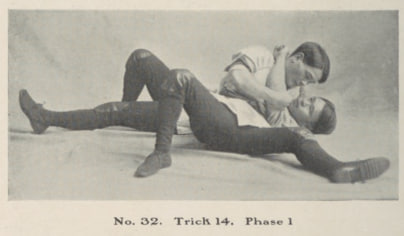
When your victim is held, as in foregoing trick, if he be very clever, he will succeed in getting a hold with his left hand at your right shoulder. In this case take a strong hold against his left arm with your right. Now, spring fairly over your victim's body, landing at his left, and, at the moment of making the spring, thrust your left arm under his neck and hold tightly. The victim may now be held helpless for twenty seconds, and then counted out.
Trick 15 — Thumb Release and Shoulder Throw 🔤 Malayalam
No. 33. Trick 15. Phase 1
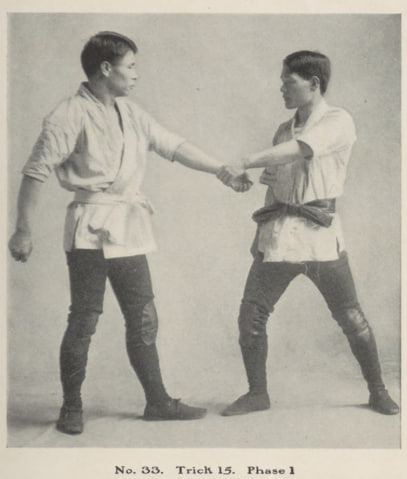
When an adversary seizes you by the coat lapel, or the edge of coat, first take off his hand. This is accomplished by forcing the ball of your thumb under the ball of his thumb, while with your second finger you press hard against the base of his thumb at the back. Force his thumb back, and he will be obliged to release his hold. As he does so, seize his wrist.
No. 34. Trick 15. Phase 2
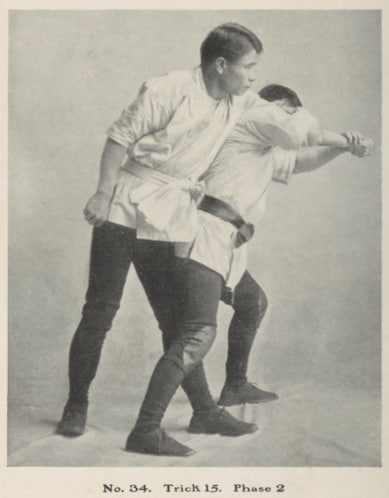
Swing to your victim's left side. If he attempts to pull away his left arm, hold tightly with your left hand, and throw your hooked right arm forcibly back of his left elbow. Now, swing still more to your left, pressing your haunch in the victim's left side and the back of your right knee strongly against the front of his left knee. At the moment of making this swing carry his captured arm over your right shoulder, keeping the palm side of his fist uppermost.
No. 35. Trick 15. Phase 3
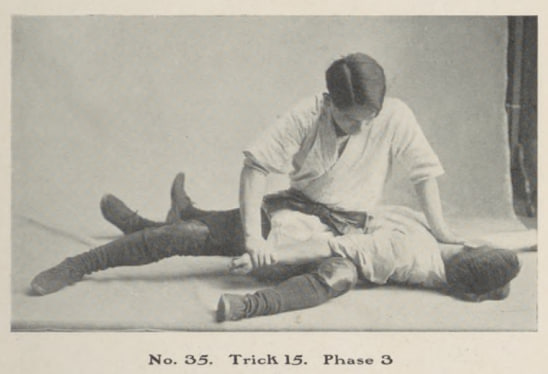
Make the throw over your shoulder, bringing the victim to the position shown above. In this, as in all other throws over the shoulder, remember to retain your hold on your victim's captured wrist! When you have brought your victim to the position shown in illustration No. 35, do not fall at his right side, as in this case you may give him an opening to free himself. Instead, fall so as to sit upon him at his left side. Bring up your left knee under the back of his upper left arm. Force his arm backward as if attempting to break it, at the same time pushing upward with your left knee to assist in the torment. Your left hand is pressed against the left side of his face so as to push his head over to the right. If you prefer, you can employ your own right hand against his jaw-bone and throat, as in Trick 13.
Trick 16 — Belt and Waist Throw 🔤 Malayalam
No. 36. Trick 16. Phase 1
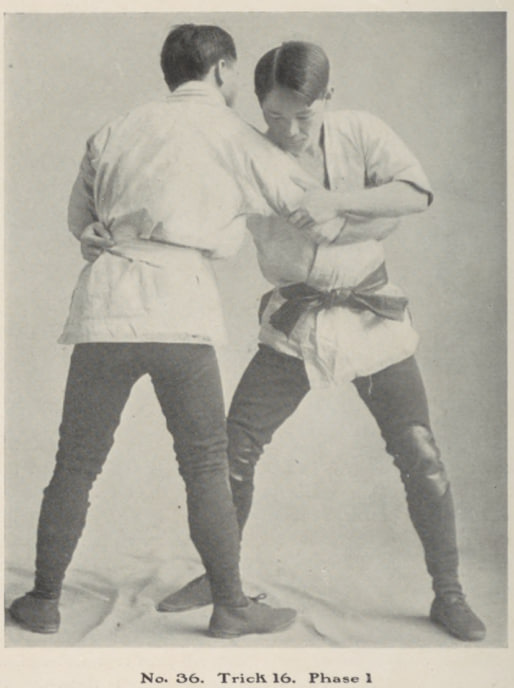
Give your opponent an opening to throw his right arm around your waist. As he does so, with your left hand seize his right upper arm at the back. Throw your right arm around your adversary's waist, seizing him at the belt over the left kidney.
No. 37. Trick 16. Phase 2
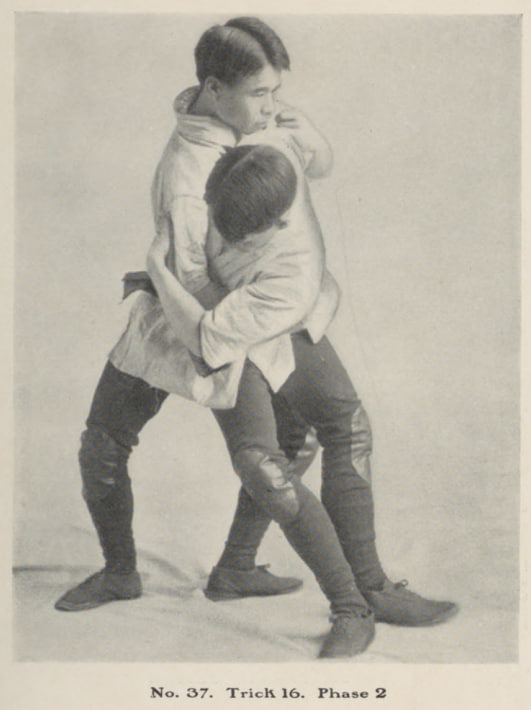
Pull hard with your right hand on your adversary's belt. This forces him to swing around and to step forward. As he does so, step forward quickly with your right foot. Lift this right foot up high so as to pass it outside his right thigh. Let your right foot land behind your opponent. Press your back against the victim's back. Bend forward, and, retaining the initial hold with your hands, you are ready for the throw.
No. 38. Trick 16. Phase 3
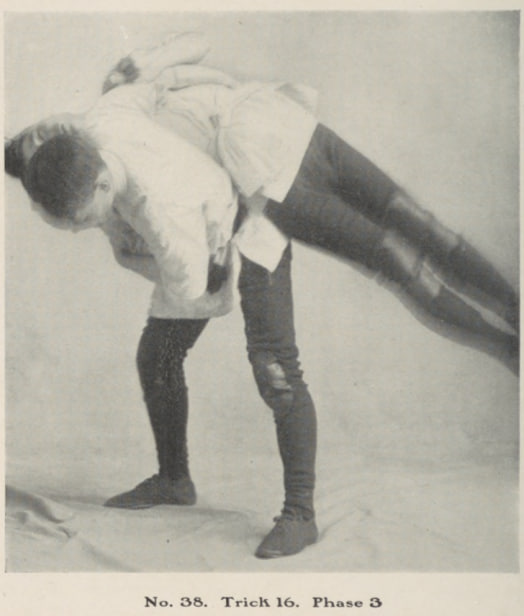
If you slip, the throw cannot be made. Bend, keeping your opponent's side on your back; then swing strongly to the left and make the throw.
Trick 17 — Knee and Elbow Press 🔤 Malayalam
No. 39. Trick 17. Phase 1
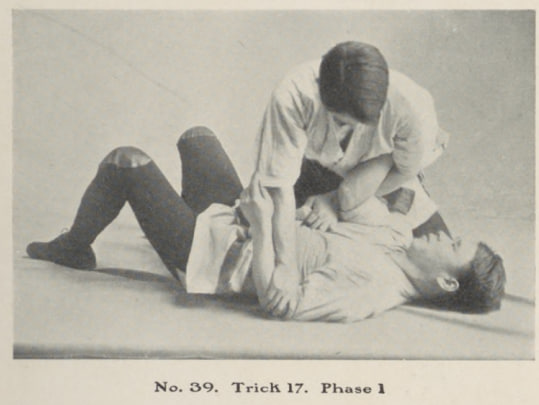
In the preceding trick, when you throw your victim, your left hand is at his right upper arm. As you throw him, fall so that your left knee presses in his neck, while your right knee presses firmly against his right kidney. Force your left arm under his right elbow, and with your left hand seize his coat. With this hold it is easy to twist his right elbow. Bending forward, thus throw more pressure against his right arm and break it, if necessary. Your right hand holds your opponent's left elbow down.
Trick 18 — Double Arm Shoulder Throw 🔤 Malayalam
No. 40. Trick 18. Phase 1
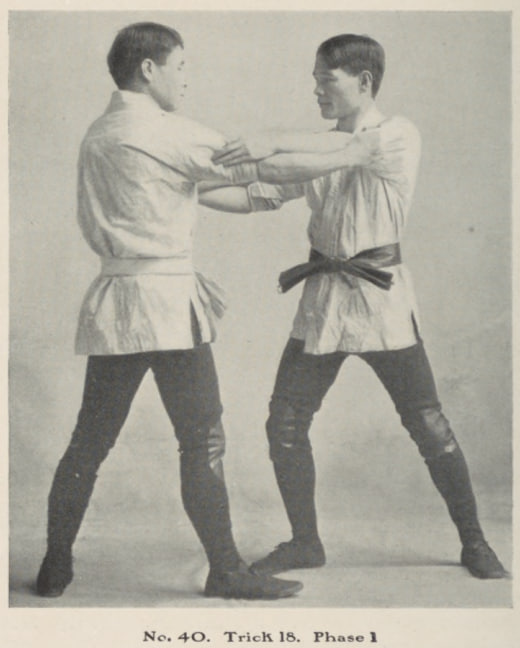
Here the opponents make an even start, for each has the same hold that the other has.
No. 41. Trick 18. Phase 2
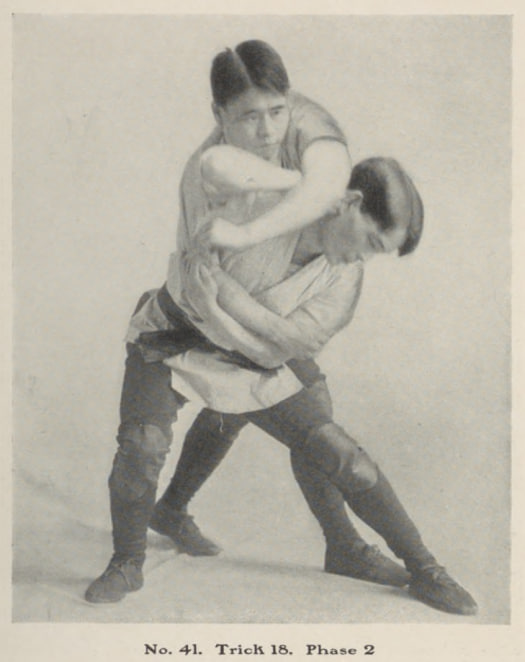
Shift your hand to an under-arm hold on your opponent's right arm, and yank that arm toward you. At the same time take a wide side step to your left. While drawing your adversary's right arm toward you, change your hold on his left arm to an under-arm hold. At this moment of pulling his right arm toward you throw his left elbow well up. Lift your right foot high, pass it by his right thigh, and, as your right foot touches the ground, turn your back to your victim. Your haunch should be pressing in his right side, and both his arms are over your right shoulder.
No. 42. Trick 18. Phase 3
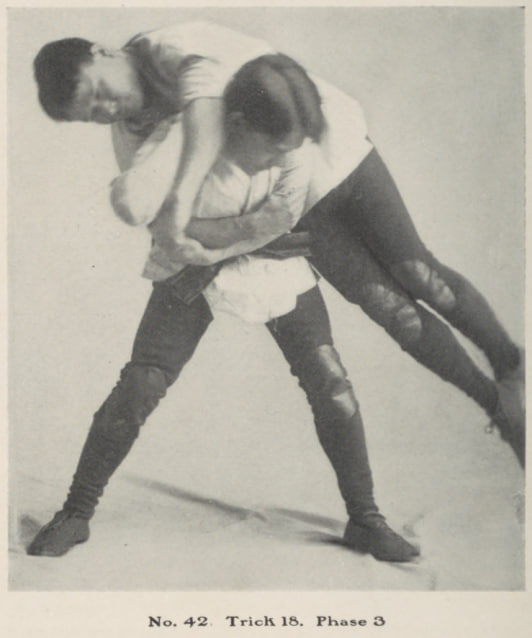
In making the throw it is highly important to bend the right knee and to hold the left leg almost rigidly straight. At the same time pull as hard as you can on your victim's left arm, and thus the throw is made.
No. 43. Trick 18. Phase 4
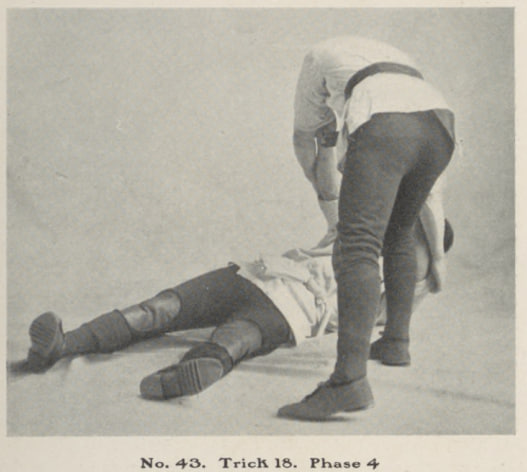
When you have made the throw you should be holding your opponent in just the same grips that you took before making the throw. In order to complete your victory it may now be necessary to employ Trick 19.
Trick 19 — Elbow Bend Submission 🔤 Malayalam
No. 44. Trick 19. Phase 1
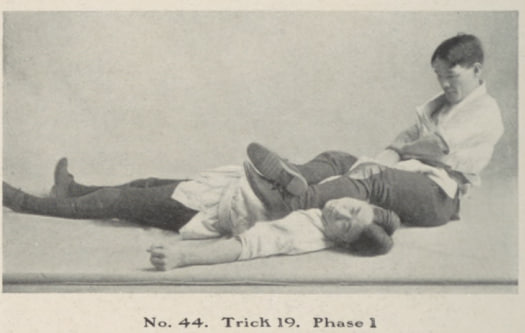
When you have secured the position described in Phase 4 of the last trick, jump to your victim's right side, keeping his right hand between your legs. His elbow is thus in position to be bent over your right leg. Throw yourself over on your back and continue the pressure on his right arm until the pain forces him to surrender.
Trick 20 — Stomach Throw 🔤 Malayalam
No. 45. Trick 20. Phase 1
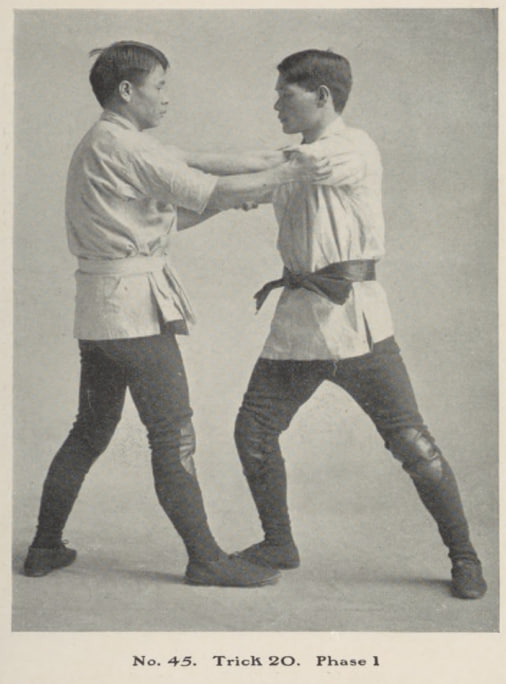
Here the combatant who wears the white belt has an excellent initial chance. His right hand has taken hold inside the adversary's sleeve, his left hand has taken an under-arm hold. The opponent in the black belt seizes both of his adversary's coat lapels.
No. 46. Trick 20. Phase 2
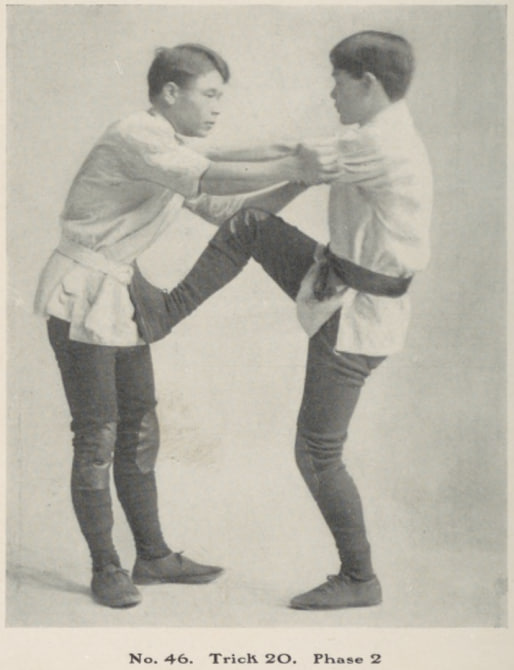
The man in the black belt pushes his adversary back with his hands. Then he pulls him toward him once more, and places a foot against the victim's stomach.
No. 47. Trick 20. Phase 3
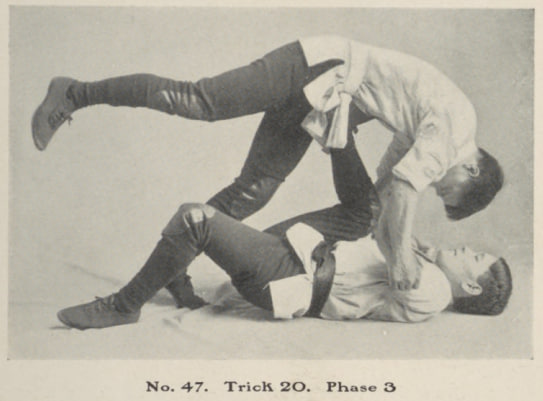
Here the man who wears the black belt pulls his victim's shoulders toward him, at the same time pushing the other's body away with his foot; and the assailant falls over backward, landing on his shoulder-blades. The victim is thrown over the assailant's head. Trick 21 is then used in sequence.
Trick 21 — Lapel Choke 🔤 Malayalam
No. 48. Trick 21. Phase 1
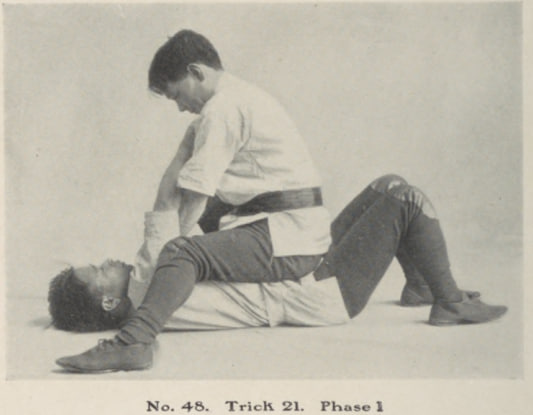
The victim of the preceding trick lands on his back. The assailant sits upon him and seizes the victim's lapels. Should the victim secure a similar hold, the assailant twists his own arms outward against the victim's arms. Thus the victim's hold is broken. In securing his own lapel hold it is highly important that the assailant seize the victim's left lapel fairly well up and the right lapel fairly well down. Now, force the left lapel severely to the right across the victim's throat, and pull downward and to victim's left with the right lapel. Thus an effective choke may be administered.
Trick 22 — Sleeve Grip and Leg Lift Throw 🔤 Malayalam
No. 49. Trick 22. Phase 1
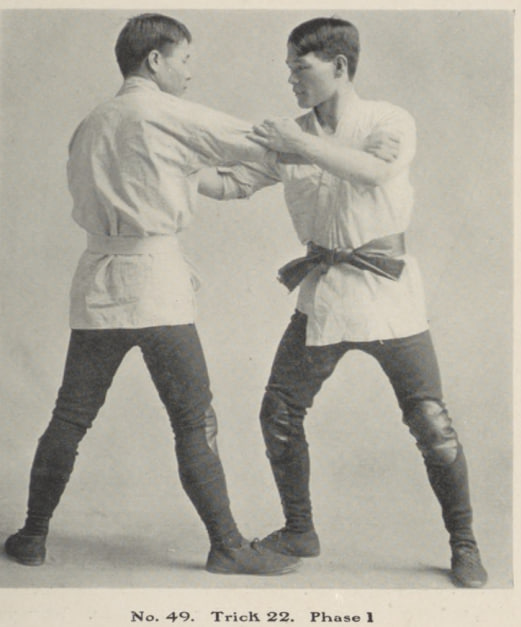
When an opponent seizes you at the upper arm, retaliate by thrusting your thumb inside his sleeve and wrapping your fingers in the cloth. Take the firmest hold possible in this manner.
No. 50. Trick 22. Phase 2
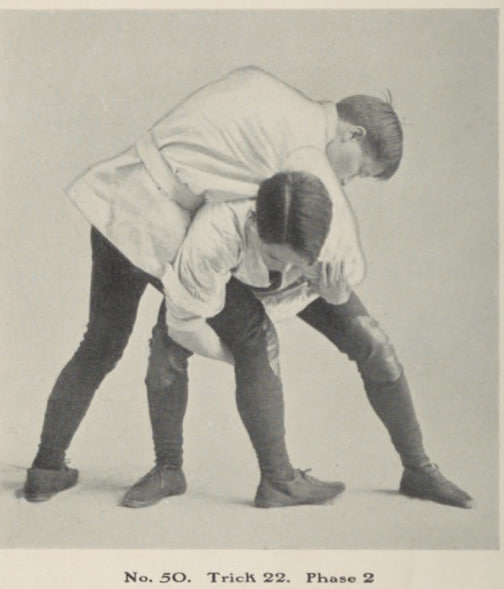
When you have your opponent's left arm thus seized, throw off the hold of his right hand. (This throwing-off is a most valuable trick, and may be accomplished in either of two ways. When you desire to throw off an adversary's clutch, release your own hand that grasps his same arm. Then, with your fist under his "funny bone," hit that bone a severe blow. Or, release your own hand, and strike the inside of his forearm severely with your elbow. Both of these methods should be practised repeatedly.) Bend forward, yanking your adversary's right arm across the back of your neck, and thrust your right arm back of his right knee.
No. 51. Trick 22. Phase 3
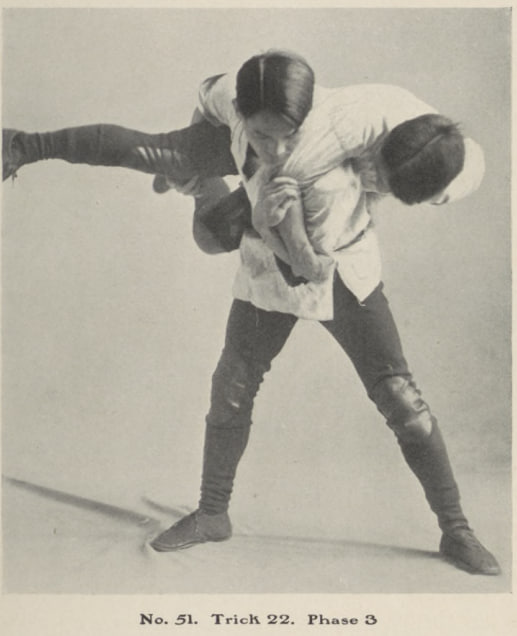
Bend still farther forward, pull strongly on your intended victim's left arm, and yank his right knee up.
No. 52. Trick 22. Phase 4
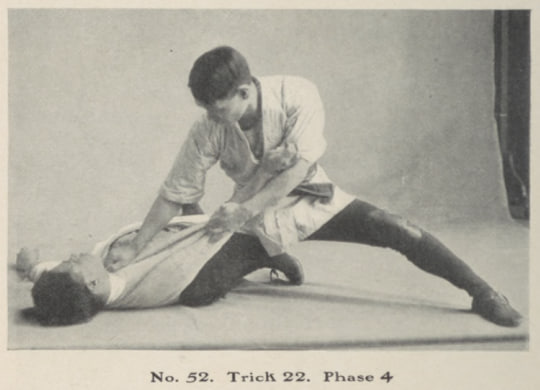
Throw your victim to the position shown in illustration. Thrust your right knee forcibly under his right shoulder. Seize his collar and push it against your victim's throat. Employ Trick 13.
Trick 23 — Neck and Back Throw 🔤 Malayalam
No. 53. Trick 23. Phase 1
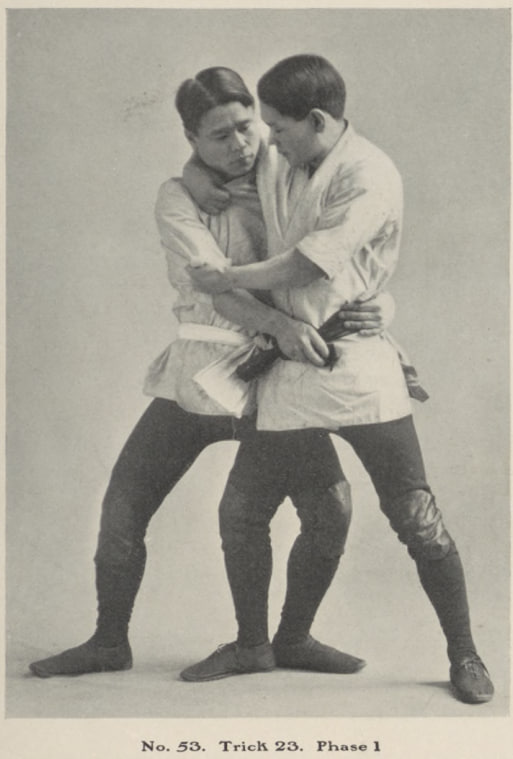
When an opponent attacks you at your right side, throw your right arm around his neck, and seize his right elbow with your left hand.
No. 54. Trick 23. Phase 2
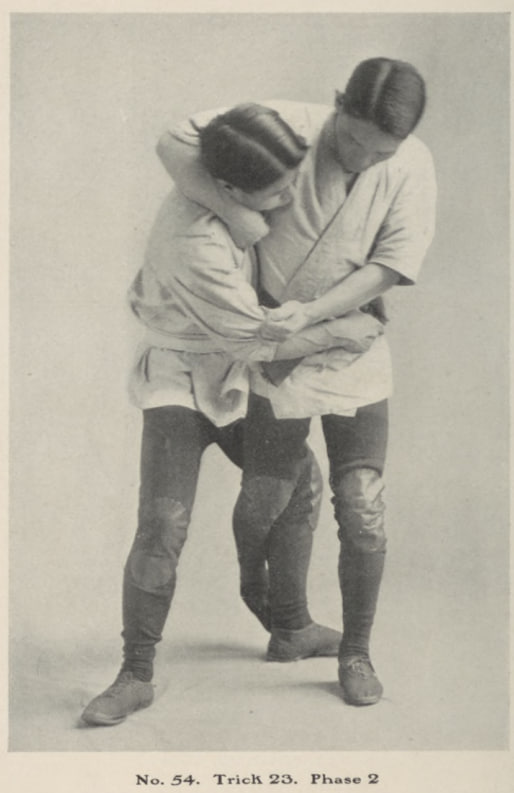
Pull your opponent's right arm forcibly toward you, at the same time wrapping your right leg around his left leg, as shown in illustration No. 54.
No. 55. Trick 23. Phase 3
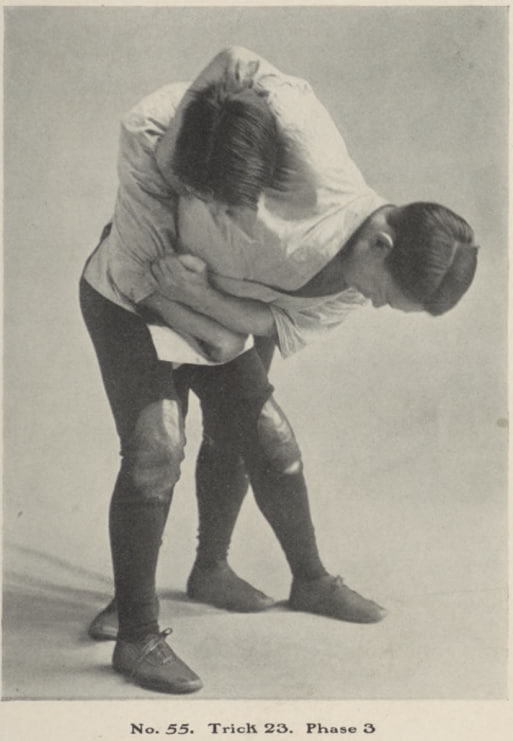
Suddenly abandon the foregoing feint and place your feet in front of your opponent's, with the backs of your knees pressing against the fronts of his knees. Your left hip should press against your opponent's right kidney.
No. 56. Trick 23. Phase 4
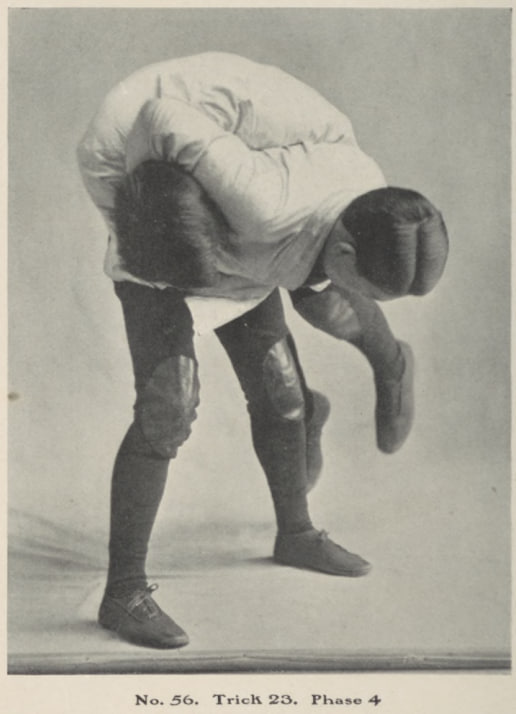
Bending well forward with your right arm over your victim's neck, throw him over your back. If necessary, lift your opponent's left knee with your left hand.
Trick 24 — Forward Neck Choke Fall 🔤 Malayalam
No. 57. Trick 24. Phase 2
Phase 1. Take the same hold as in Trick 23, Phase 2.
Phase 2. (No illustration.) When you throw your right arm around your opponent's neck, seize his right elbow with your left hand. This leaves him no hold except to seize you around the waist with both arms. Now, suddenly change your right arm so that it is around your adversary's neck from in front, thus forcing his head backward. At the same time press your right knee against the back of his left knee, and fall backward. This causes your victim also to fall backward, and, as he falls, with your right arm you can administer severe, dazing choking.
Trick 25 — Jaw Crush 🔤 Malayalam
Trick 25
Phase 1. The same hold is taken as is described in Phase 2 of Trick 23.
Phase 2. (No illustration.) With your right arm still around your victim's neck, and your right foot still wrapped around his left lower leg seize your own right wrist with your left hand. Pull your right forearm strongly toward your shoulder, thus severely crushing your adversary's jaw between your right shoulder and your right forearm, as if you held his jaw in a strong vise. This crushing of the jaw is a terrible punishment. As soon as you have begun the crushing of your adversary's jaw, throw yourself forward on your knees, carrying him down with you. Continue the jaw-crushing pressure until your opponent surrenders.
Trick 26 — Knee Kick Backward Throw 🔤 Malayalam
No. 58. Trick 26. Phase 2
Phase 1. (No illustration.) Your opponent has seized you with his right hand at your left upper arm, and his left hand at your right elbow
. 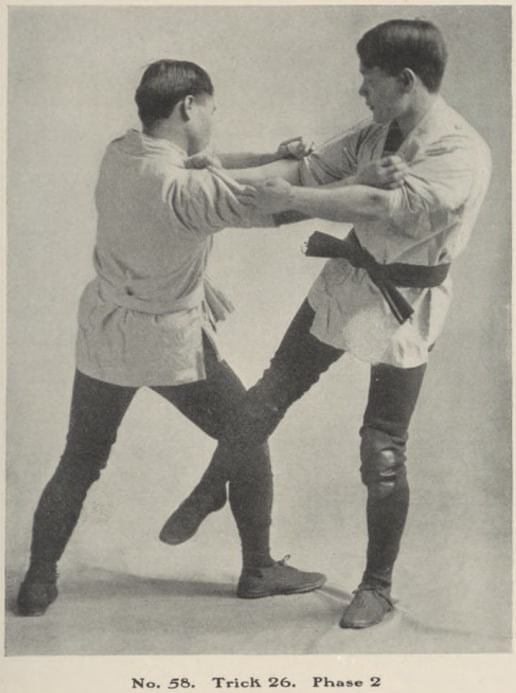
Phase 2. Pull your assailant's right arm toward you, at the same time stepping well back on your left foot. This forces your assailant to advance his right foot. Now, release your right-hand hold on his left arm and press your right hand against his right shoulder. At the same instant kick the back of your adversary's right knee with the back of your own right calf. While doing so pull at his right arm, push at his right shoulder, and thus throw him over backward.
Trick 27 — Elbow Hold Leg Throw 🔤 Malayalam
No. 59. Trick 27. Phase 1
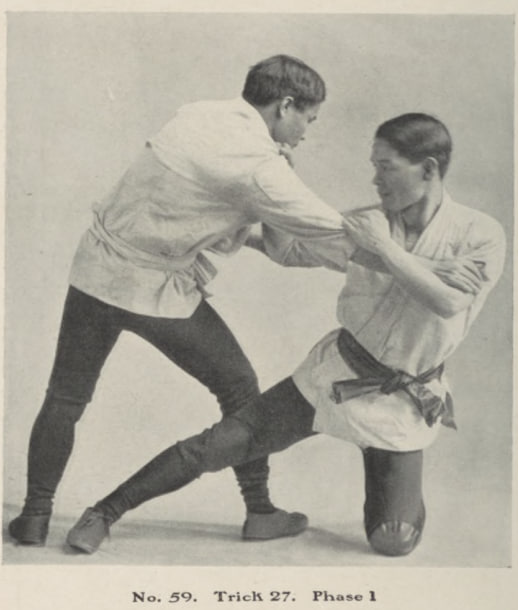
When your opponent has seized you at your upper arm, take an elbow-hold as shown in illustration No. 59. Release your right arm by one of the throw-offs already described. All that follows is done almost simultaneously. With your left hand pull your opponent's right arm toward you. With your right hand seize his left shoulder and push against it. Your adversary, when his right arm is pulled, will advance his right foot. Thrust your own right leg forward and past the outside of his at the knee. Sink to your left knee. Throw your opponent over your extended right leg.
Trick 28 — Ankle Hook and Leg Throw 🔤 Malayalam
No. 60. Trick 28. Phase 1
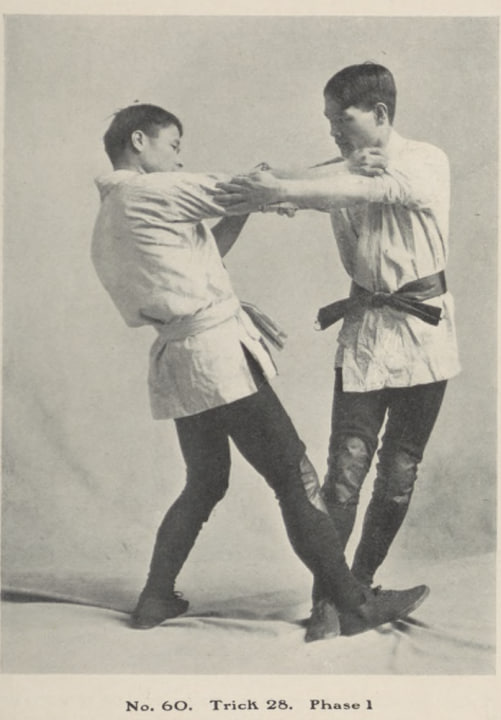
When your opponent wishes to throw you to his own left side, he feints as if intending to throw you to his right. As he does so, hook your right foot back of his right ankle, which will prevent him from lifting and placing his right foot in such manner that he can make the throw.
No. 61. Trick 28. Phase 2
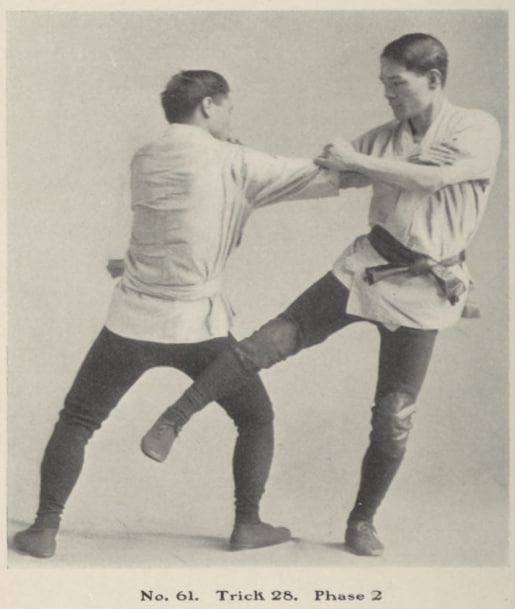
Follow up this advantage by releasing your right arm by means of a throw-off. With your right hand seize your adversary at his right shoulder. With your left hand pull his right arm forcibly toward you, and throw your right leg back of his as if to kick it from under him. But this is only a feint—"teasing."
No. 62. Trick 28. Phase 3
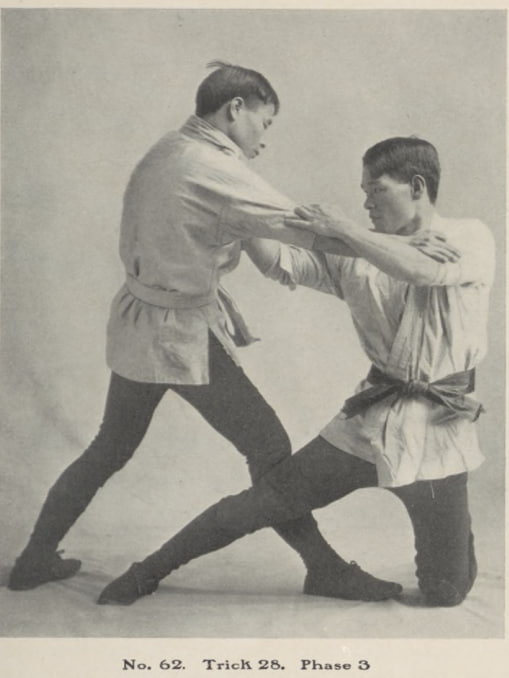
Again pull your adversary's right arm toward you with your left hand, and with your right hand again push at his right shoulder. At the same time fall upon your left knee, and extend your right leg, which must be rigid, past the outside of his right leg, just below his knee. Now, throw your opponent over to his right.
Trick 29 — Jugular Strangle-Hold 🔤 Malayalam
No. 63. Trick 29. Phase 1
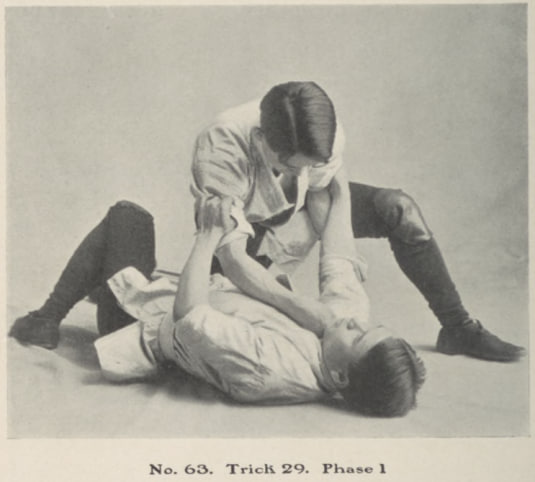
When you have thrown your victim, by means of the preceding trick, retain the hold with which you threw him. With your left hand, that has the hold at his elbow, push his elbow severely as if trying to force his arm to "bend the wrong way." With the right hand, that has a hold at your adversary's right shoulder, press against his jugular vein, in order to strangle him.
No. 64. Trick 29. Phase 2
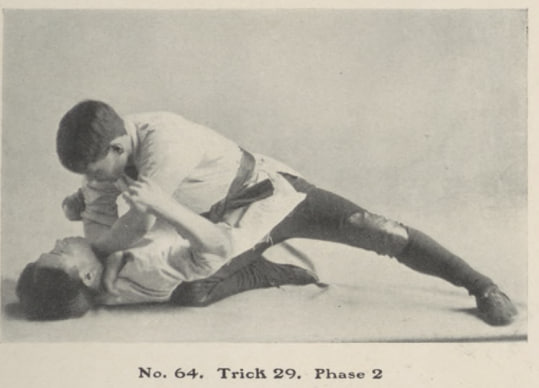
Now force your right knee under your victim's right shoulder. Here one form of strangle-hold is employed. Insert your right hand under the victim's coat-collar as far around to the left as you can secure the hold. Pass your left arm under your right arm and seize the victim's right coat collar. It is highly important that, in securing this hold, the backs of your hands be toward the victim and your palms toward yourself. Now, retaining the hold, draw the hands closer together in order to effect the strangulation. In this strangle-hold your muscular strength must be applied from the elbows.
Trick 30 — Lapel Shoulder Throw 🔤 Malayalam
No. 65. Trick 30. Phase 1
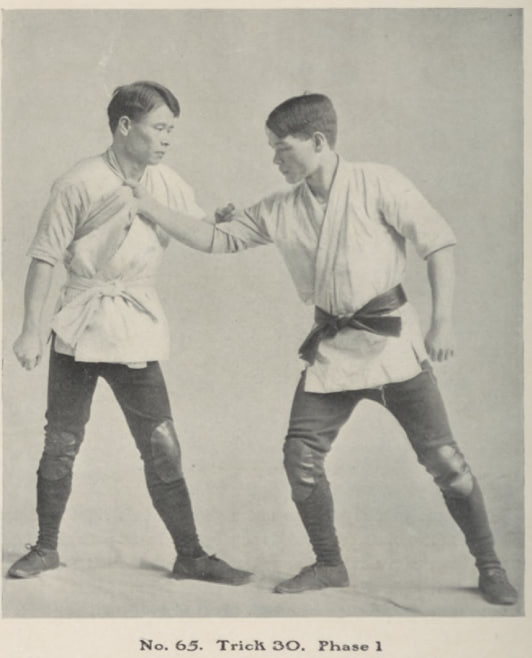
You have thrown off your opponent's hold on one side, as explained in Trick 22. At the moment of taking the hold, your left foot was forward. Now, step your left foot well backward. Do not straighten the arm that has hold at your adversary's lapel! If you do, your adversary will have a chance to break your arm! So, let your attacking arm remain bent, as shown in illustration No. 65.
No. 66. Trick 30. Phase 2
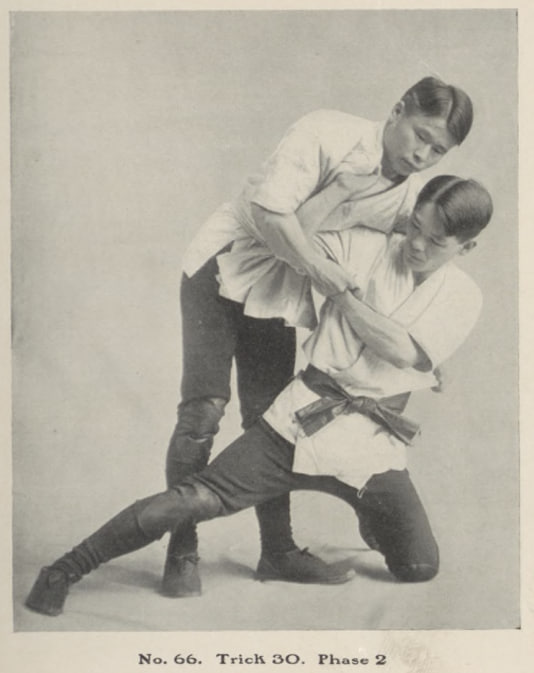
Swing your body slightly, and bring your left foot just outside your opponent's left foot. This leads your opponent to believe that you intend to throw him to his left. It gives him also an opportunity to throw you to your right. But instantly, before your victim can take advantage of this opening, swing your body again so that you thrust your extended, rigid right leg past the outside of his right leg, and, in the same swift movement, drop to your left knee.
No. 67. Trick 30. Phase 3
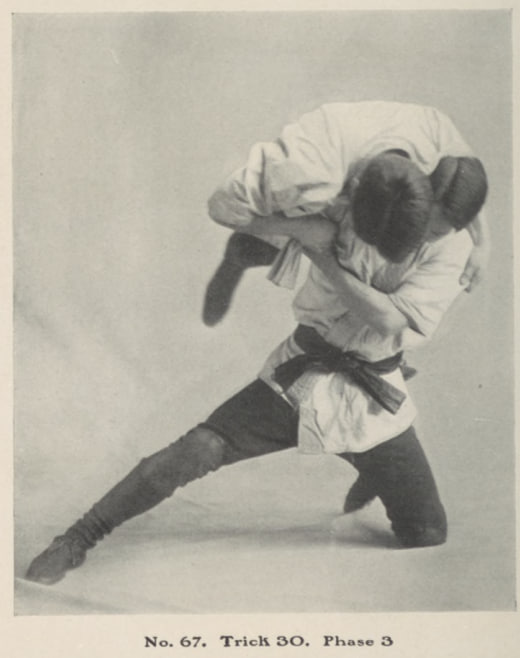
Bending well forward, throw the weight of your body on your left knee. Your right hand is already at your adversary's coat lapel. With your left hand seize the right edge of his coat below the lapel. Throw your victim over your right shoulder.
No. 68. Trick 30. Phase 4
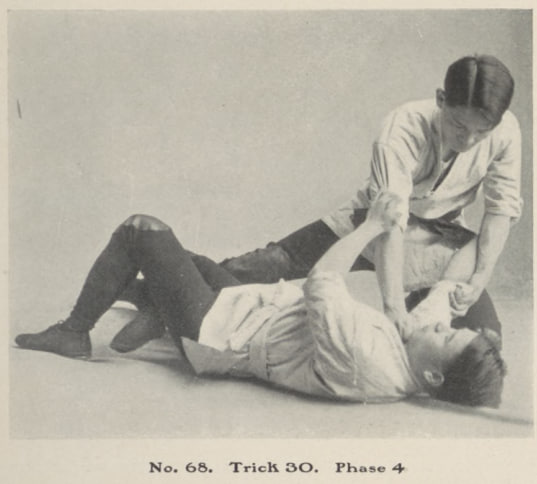
In this case, as in all other cases where you make a throw, be careful not to lose the hold that you had at the moment of making the throw. Your left knee is close to your victim's head. Your right leg, still extended, is under your victim's right leg. Hold his captured right arm strongly over your left upper leg. With your right hand grip tightly at the lapel, ready for the employment of the next trick.
Trick 31 — Knuckle Strangle-Hold 🔤 Malayalam
No. 69. Trick 31. Phase 1
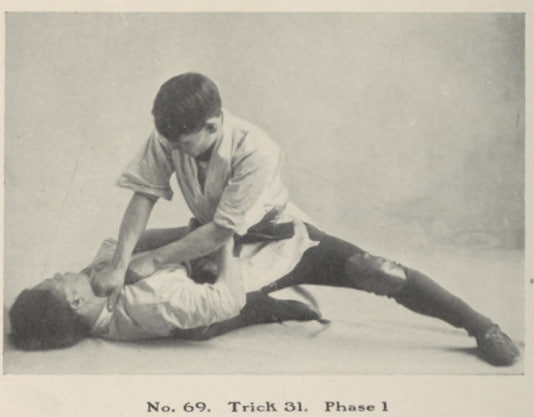
This is another strangle-hold. Take it exactly as shown in illustration No. 69. If your elbows are bent your victim has a chance to knock your elbows up and to save himself from much of the strangulation. Note how the arms are held in the illustration. They are bent but little, and your left elbow is close to your left side. The second knuckle of the second finger of your right hand protrudes in advance of the other knuckles, and is pressed into the victim's right jugular. Your left hand, just below your right hand, seizes the victim's left lapel and pulls it strongly over toward his right shoulder. This completes the strangulation.
Trick 32 — Toe Tread and Head Strike 🔤 Malayalam
No. 70. Trick 32. Phase 1
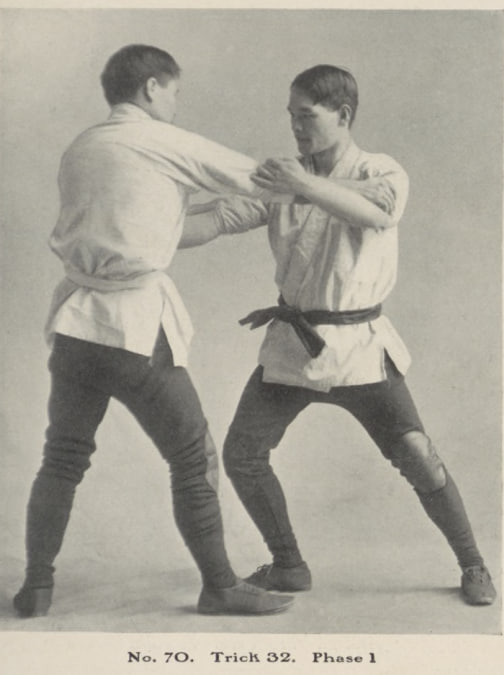
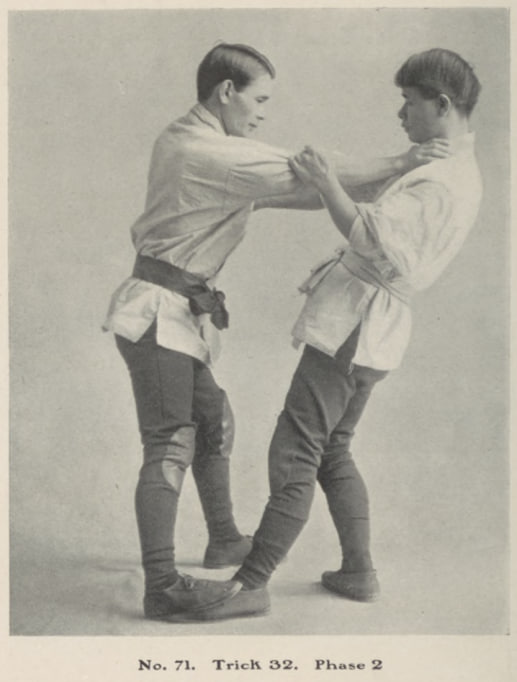
Your opponent has seized you, and brings his right foot forward inside your right foot. His left hand has an under-hand hold on your right arm. Shift your right hand so that you have an under-hand hold on his left arm.
No. 71. Trick 32. Phase 2
Side-step with your left foot. This forces the adversary to bring his left foot forward and outside your right foot, as, if he did not do this, he would be in a position to be thrown quickly. As your victim brings his left foot forward, use your right foot to step firmly on his left toes. At the same time use your right hand to push against his neck.
No. 72. Trick 32. Phase 3
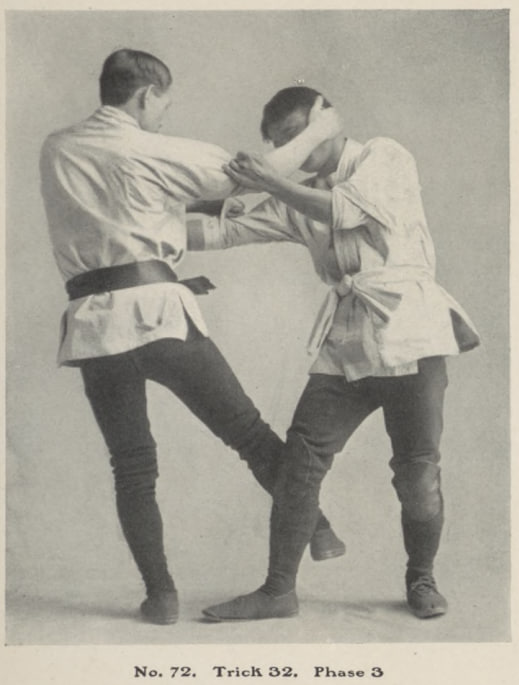
Of course your victim will try to pull away his captured foot, and he may succeed. So, to forestall him, raise your right foot and with your right calf quickly kick the outside of his right leg. In the same instant raise your right hand from his neck and strike him a smart, forceful blow at the side of his head, thus sending him to the ground over your right leg.
Trick 33 — Belt and Sleeve Leg Throw 🔤 Malayalam
No. 73. Trick 33. Phase 1
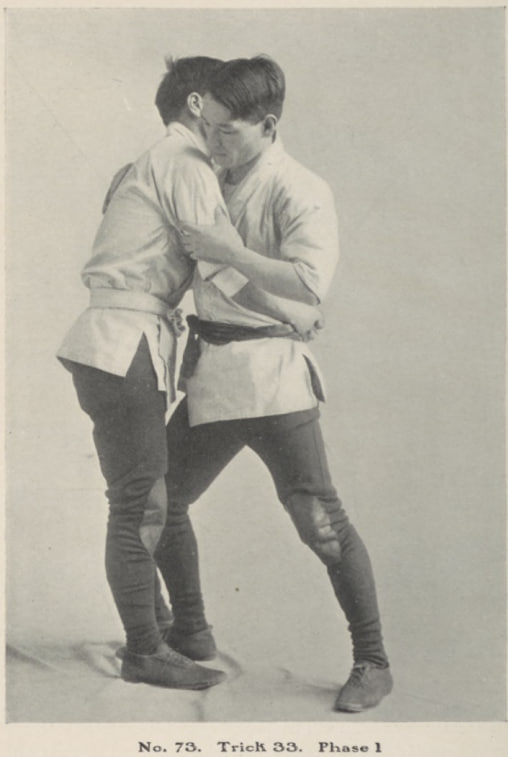
It must be borne in mind that a crafty jiu-jitsian always seems to give his opponent splendid opportunities. In this instance you have given your adversary a chance to seize you at the belt. Grab his right upper arm, as shown in illustration No. 73. Here your right leg is forward.
No. 74. Trick 33. Phase 2
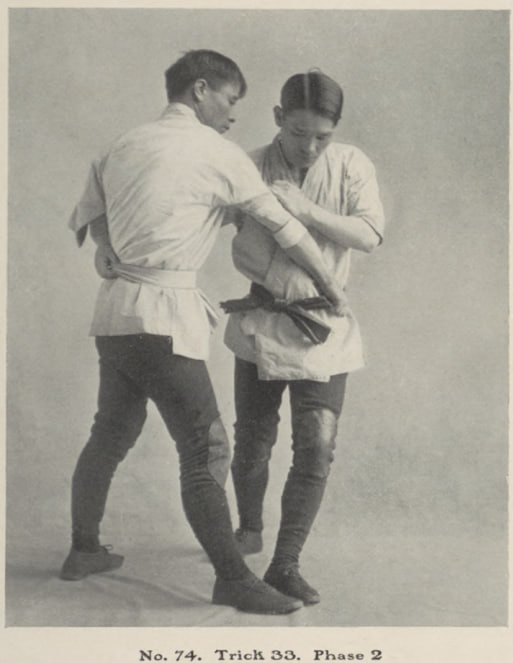
Step well back on your right foot, and this gives you an opportunity to throw your right arm around your opponent's waist, seizing him at the belt.
No. 75. Trick 33. Phase 3
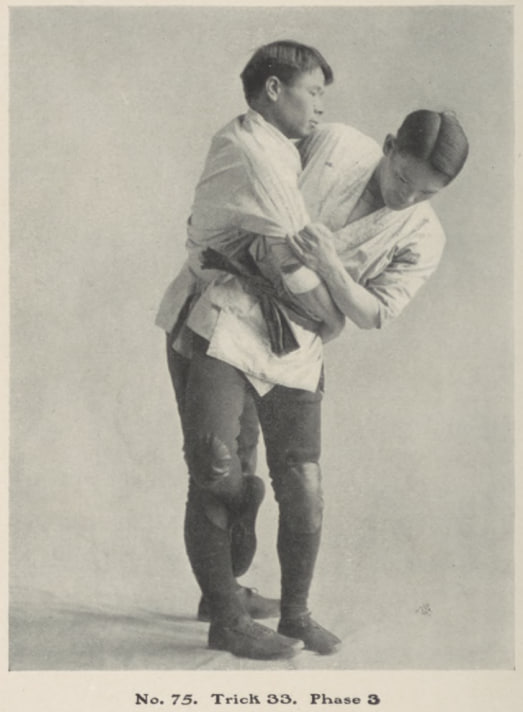
Bring your left foot close to your opponent's right, bending your left leg slightly. Pull hard on his right sleeve. Throw your right leg outside his right leg, in order to hold his right knee wedged, as shown in illustration No. 75.
No. 76. Trick 33. Phase 4
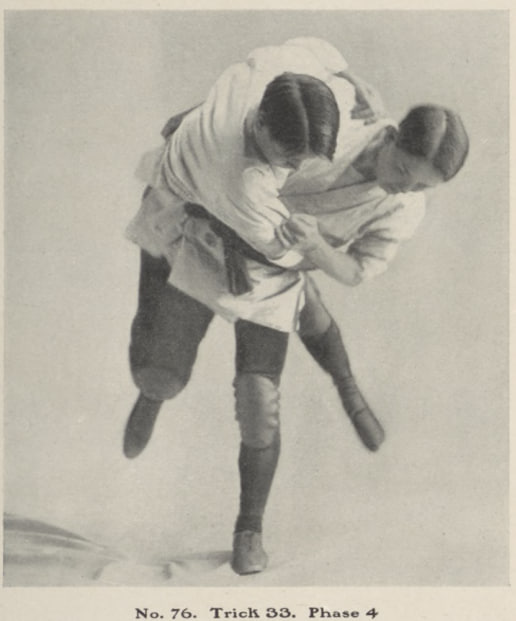
With your right leg placed as in the last phase, pull up hard on your adversary's belt with your right hand; with your left hand pull his right arm forcibly around toward you, and with your right foot kick his right leg from under him, and thus make the throw.
Trick 34 — Knee Swing Throw 🔤 Malayalam
No. 77. Trick 34. Phase 1
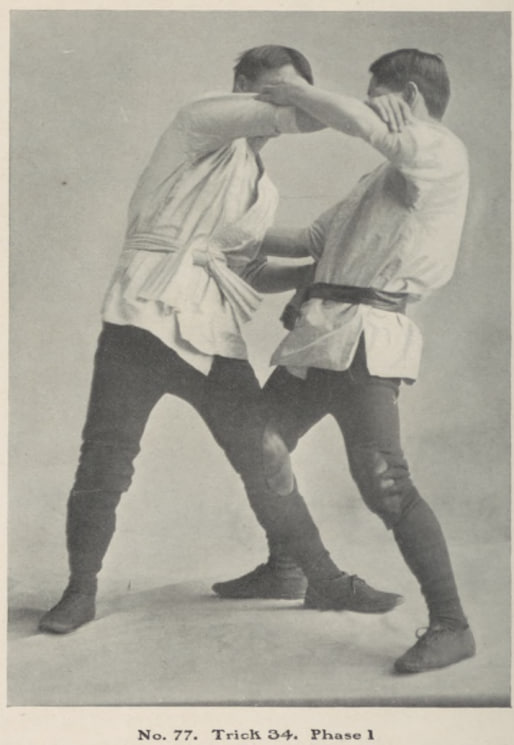
Here both contestants are feinting—"fooling," the Japanese call it. Each is watching for an opportunity. Your opponent's right hand has seized your upper arm, and you have caught him at the elbow. The hold on the other side is unimportant. Bring your right leg outside your opponent's left, on which he is bearing his weight.
No. 78. Trick 34. Phase 2
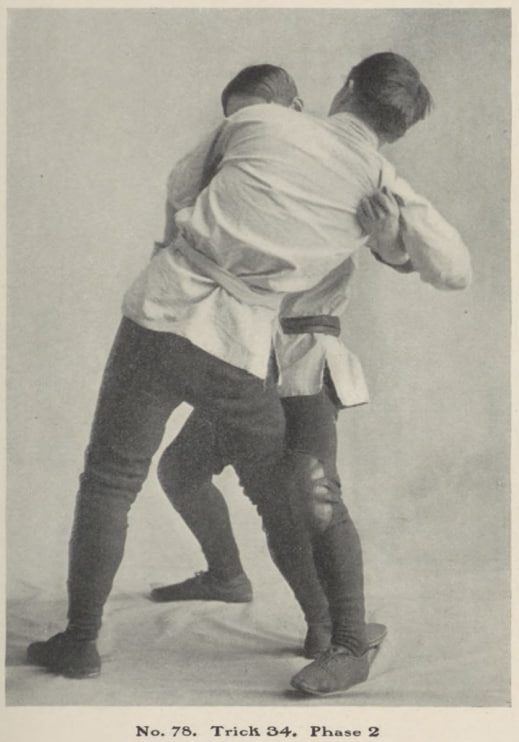
In order to save himself your opponent has brought his right foot forward. At just the instant that he does this, swing your left leg around outside his right leg, so that your left knee is pressing against his right knee. And, in the same instant, shift your left hand to a hold at the back on his right shoulder. Make the throw by swinging your opponent forcibly over your left knee. In doing this you will aid yourself by swinging your own body around considerably.
Trick 35 — Crotch Lift Throw 🔤 Malayalam
No. 79. Trick 35. Phase 1
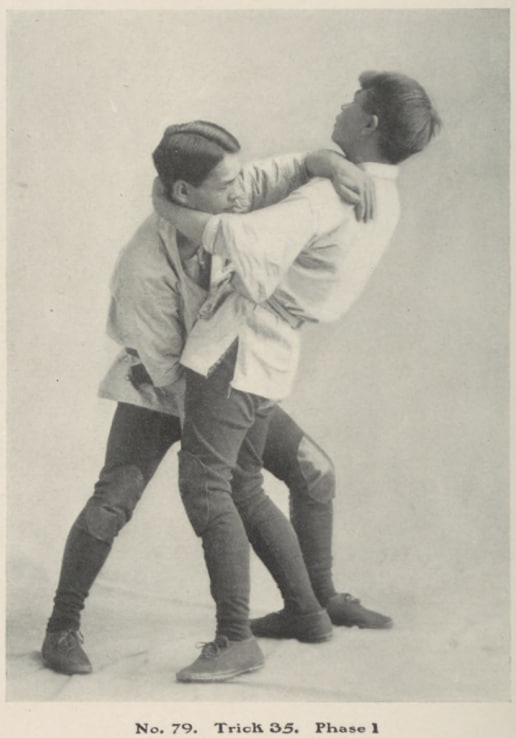
Your opponent has closed with you, and has thrust one thigh back of your thigh to throw you over backward. Frustrate this attack by stepping quickly outside your adversary. Thrust your right hand under his crotch, seizing the cloth at the back of the crotch. Your left hand flies over to his left shoulder.
No. 80. Trick 35. Phase 2
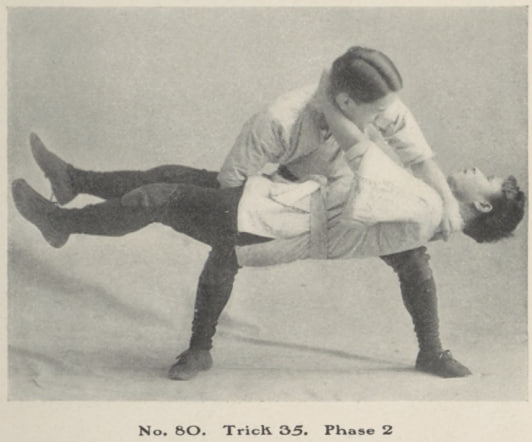
With the leverage afforded by your hand at his crotch, push hard with your left hand at his left shoulder, and throw him over your knees, as shown in illustration No. 80.
No. 81. Trick 35. Phase 3
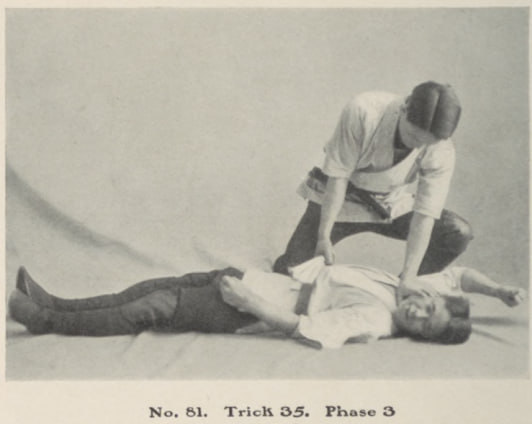
As your victim falls, bring him to submission by falling with your left knee on his right arm, pulling up at his belt with your right hand, and using your left hand so that the tip of your second finger presses against the nerve under the lobe of his right ear, while your thumb digs against his jugular vein.
Trick 36 — Wrist Yank Backward Fall 🔤 Malayalam
No. 82. Trick 36. Phase 1
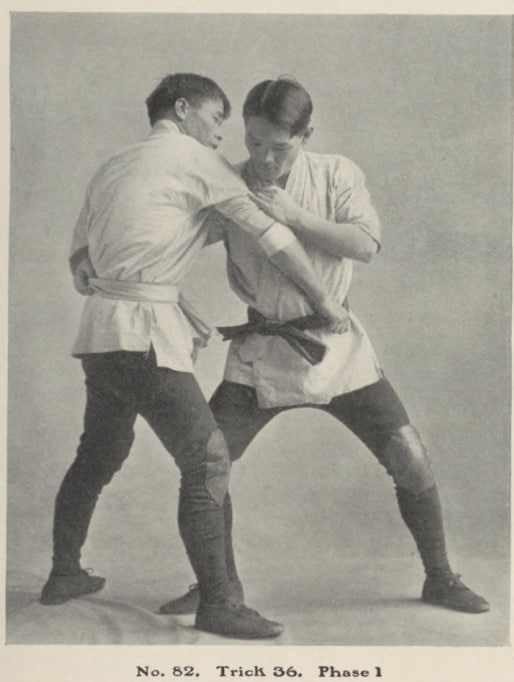
Note the position that has been taken here, as shown in illustration No. 82.
No. 83. Trick 36. Phase 2
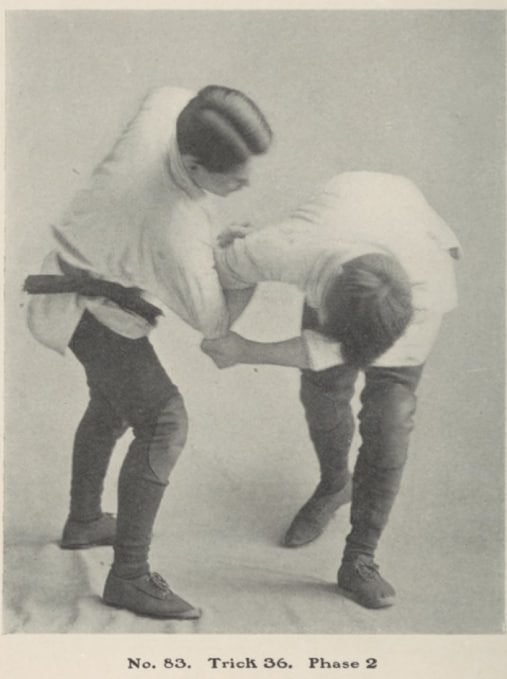
Release your hold around your adversary's waist. With your left hand gripping his right wrist, yank that wrist to your left side. Your right hand must seize his right upper arm at the back.
No. 84. Trick 36. Phase 3
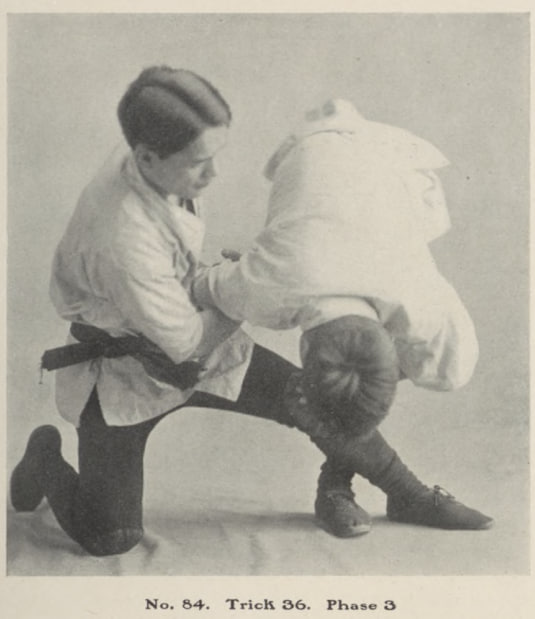
Now, quickly swing around, so as to fall upon your right knee, extending your left leg, held rigid, in front of your antagonist's left leg. With severe pressure upon his right arm—this pressure is gained through the hold that you have just taken on the victim's captured right arm—fall over backward. This trick, when applied with much force, will break your opponent's arm. It is highly important to devote much practice to this trick, and always to remember it in the hour of need.
Trick 37 — Arm Bend Face Push 🔤 Malayalam
No. 85. Trick 37. Phase 1
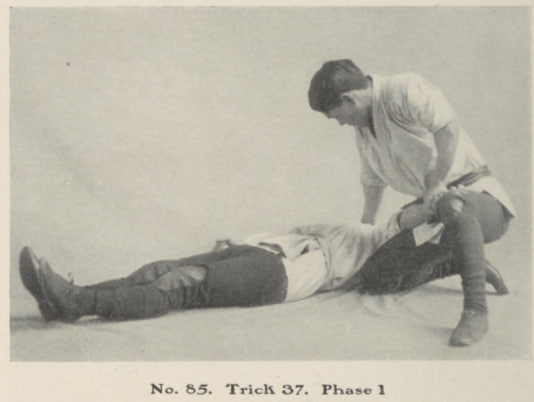
When you have thrown your opponent by means of Trick 36, an opportunity will present itself to use this trick. Your right knee is at your victim's left side. Bend his left arm backward over your right leg, holding his left wrist with your left hand. Push the palm of your right hand against the left side of your victim's face, thus forcing and holding his head away from you. The arm-breaking pressure on your adversary's left arm will force him to surrender.
Trick 38 — Wrist Break Submission 🔤 Malayalam
No. 86. Trick 38. Phase 1
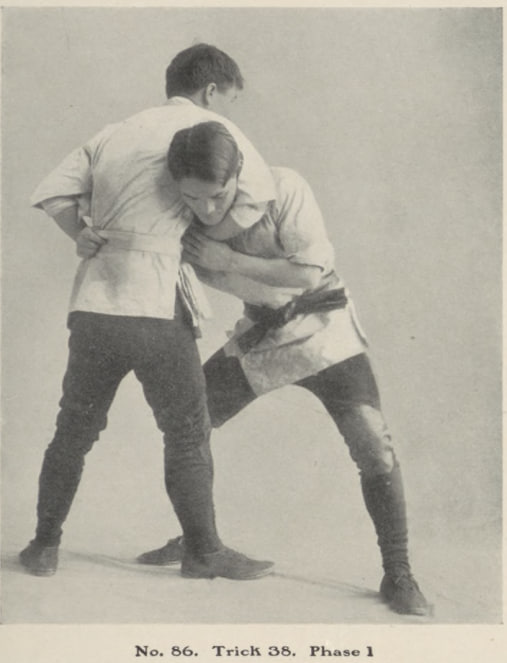
When your opponent secures a chancery hold, as shown in illustration No. 86, throw your right arm around his waist, gripping at his belt or coat in the rear. With your left hand seize his right wrist. Protect yourself from a choking by depressing your chin as much as possible upon your chest and making the neck muscles as tense as you can.
No. 87. Trick 38. Phase 2
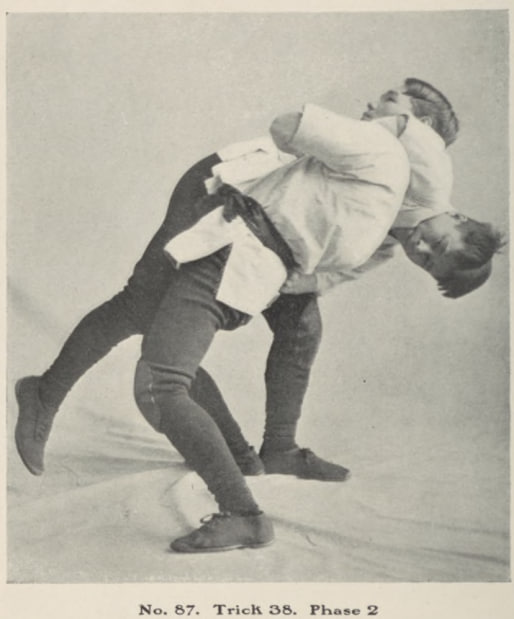
The assailant's right wrist has been secured and held at just the point where the wrist and the back-of-the-hand bones join. Retain both holds secured with your hands. Dart your right leg between your opponent's two legs. Use your left leg to press against his right leg, as shown in illustration No. 87. Now throw yourself over backward. As soon as you have fallen half-way backward—in other words, as soon as you have gotten your opponent off his balance, and have started him to going over with you—release the hold at his belt and with your right hand also seize his right wrist.
No. 88. Trick 38. Phase 3
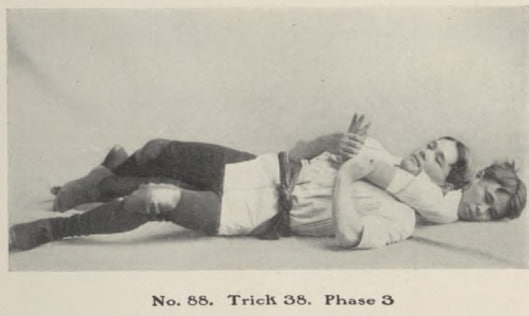
When it is necessary to break an opponent's wrist, begin by bending his thumb backward. The thumb is to be bent in the direction that it would go if you were trying to lay it over upon the outer edge of the forearm, and the pressure is applied against the ball of the thumb, just as if it were the nail of the thumb that you wished to make touch first against the outer edge of the forearm. This direction for bending the thumb should be studied carefully. When you have thrown your opponent, as shown in illustration No. 88, press your lower head and neck firmly against his shoulder. At the same time twist your right foot around his right foot in order to complete your secure hold on your victim. Now, all is ready for the application of "submission." With your left hand apply pressure as if to break your victim's thumb, as described above. Fold the fingers of your right hand over your victim's palm and press the ball of your right thumb against the back of his captured hand at a point now to be described. Follow with the ball of your thumb the line between the roots of the two middle fingers. Not quite half-way down the back of the hand your thumb tip will come to a point where the bones appear to join. Severe pressure here with your thumb will cause pain. (Of course practice must be had until this spot can be located instantly.) With the hold secured with your right thumb and fingers, twist your victim's wrist until he surrenders. Study the illustration carefully.
Trick 39 — Lapel Drag Backward Fall 🔤 Malayalam
No. 89. Trick 39. Phase 1
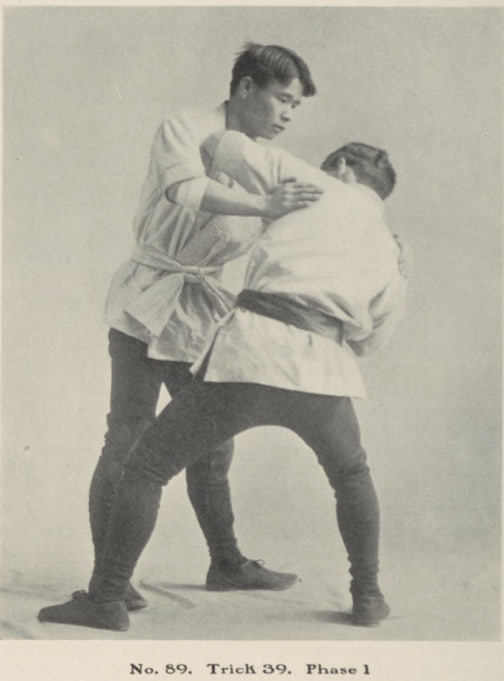
With your right hand seize your opponent at his left arm, with your thumb thrust inside his sleeve. With your left hand seize his left lapel, then using your left elbow to press forcibly against his right chest just inside the shoulder. This prevents your opponent from closing in with you.
No. 90. Trick 39. Phase 2
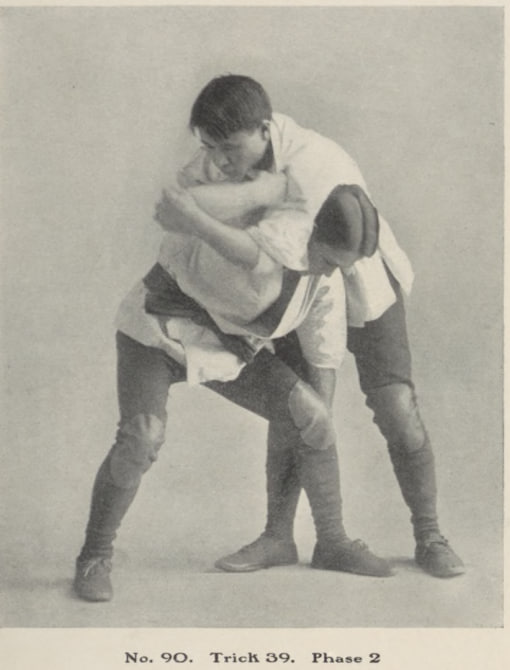
Suddenly release your right-hand hold, if necessary throwing off your opponent's arm as described in Trick 22. Your right hand now seizes your victim's left lapel. With your left hand let go altogether. Now, turn swiftly so that your left side is to your victim. With your right hand drag him over your shoulder. With your left hand seize him at the back of his right knee.
No. 91. Trick 39. Phase 3
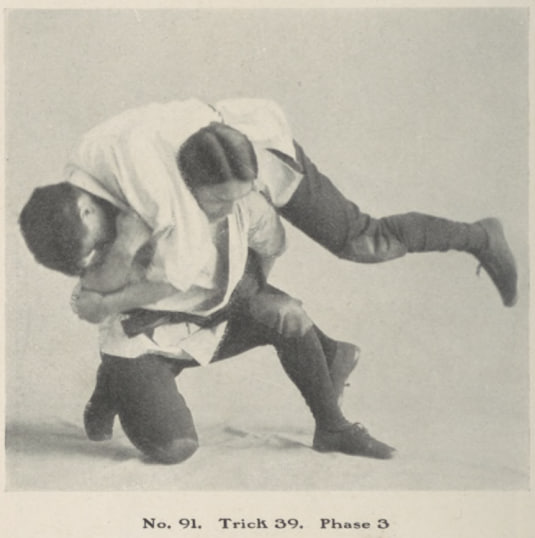
Your victim thinks he is to be thrown over your shoulder, and naturally he pulls back to resist. As he does so, throw yourself over backward. This lands the victim on his back, while you lie on your back across his body.
Trick 40 — Waist Grip Leg Lift Throw 🔤 Malayalam
No. 92. Trick 40. Phase 1
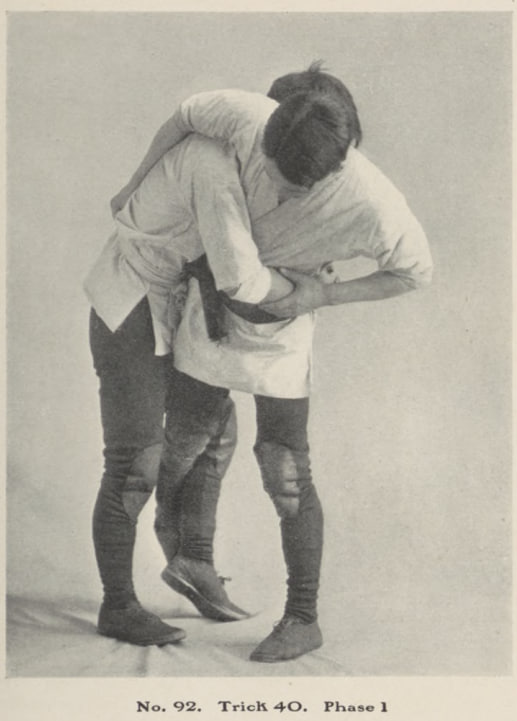
Your opponent may seize you at your side, throwing both arms around your waist, as shown in illustration No. 92. Now, throw your right arm over your assailant's right shoulder and with your right hand seize him at his trousers-strap, top of trousers, or at belt in rear. With your left hand seize his right forearm. Wrap your right leg around his left leg as shown in the illustration.
No. 93. Trick 40. Phase 2
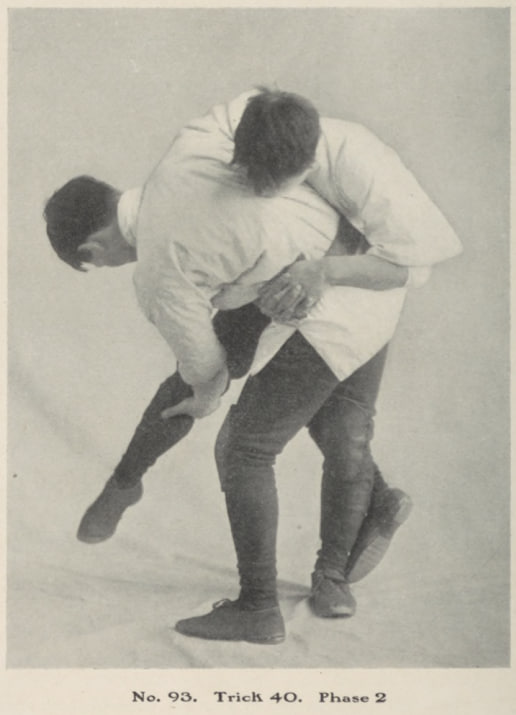
Lowering your body, with your left hand seize your opponent at the inside of his right knee.
No. 94. Trick 40. Phase 3
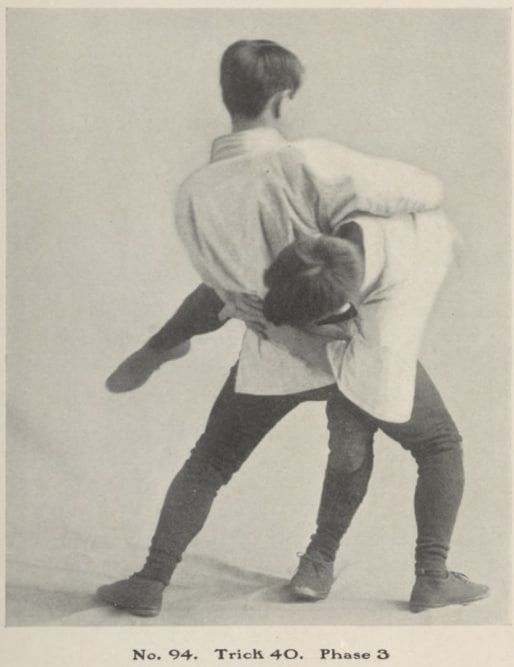
Now release your right leg, which has been wrapped around your opponent's left leg, and step your right leg well outside his left. Throw yourself backward, at the same time lifting his captured right knee. As you touch the ground your right arm necessarily administers a severe shock to your victim's neck, but it may be necessary to follow up your advantage by employing Trick 41.
Trick 41 — Jaw Press Hold 🔤 Malayalam
No. 95. Trick 41. Phase 1
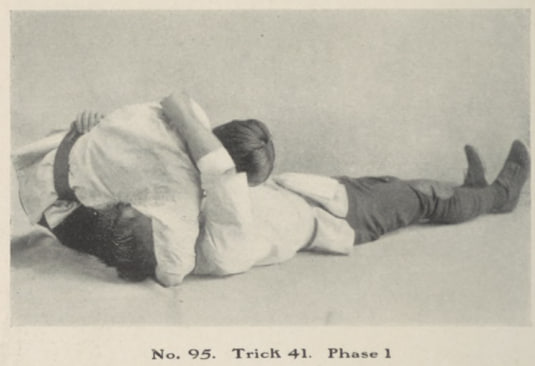
When you have thrown your victim by means of the preceding trick, you have fallen with your right knee pressing against the back of his head. Your right arm is around his neck and your upper right arm presses severely against his upper jaw just under the nose. Wrap your left arm around his left arm so that your hand rests on his back. Thus your victim is held helpless, and the pressure against his upper jaw forces him to surrender.
Trick 42 — Flying Mare Counter 🔤 Malayalam
No. 96. Trick 42. Phase 1
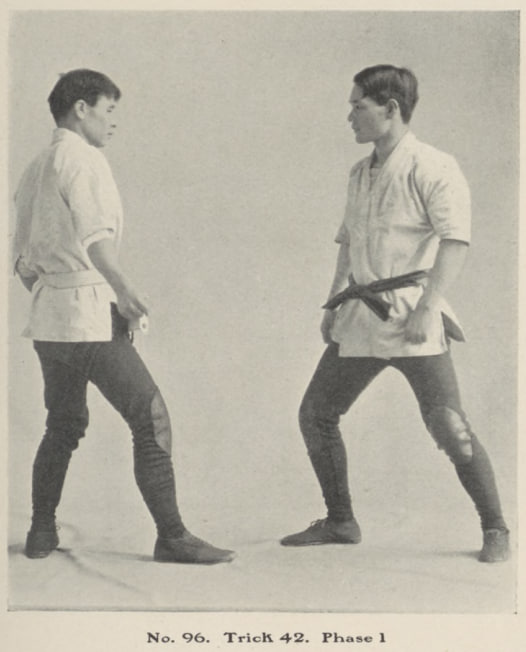
Study the exact positions of the contestants in illustration No. 96, as they face each other for the encounter.
No. 97. Trick 42. Phase 2
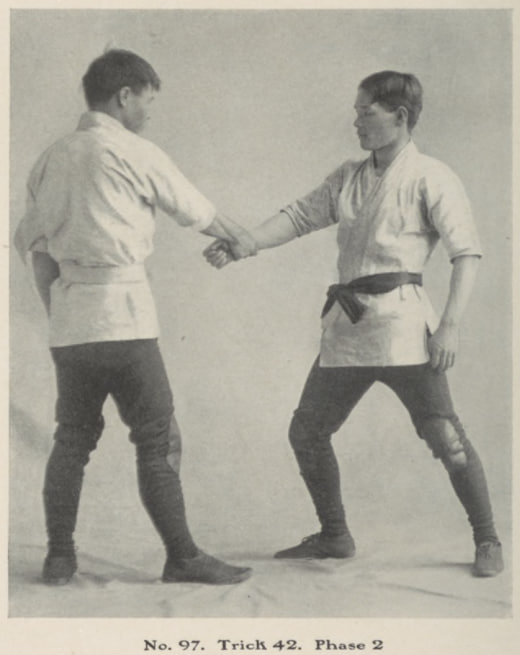
As you try to seize your adversary's lapel he counters by seizing your wrist, as shown in illustration No. 97.
No. 98. Trick 42. Phase 3
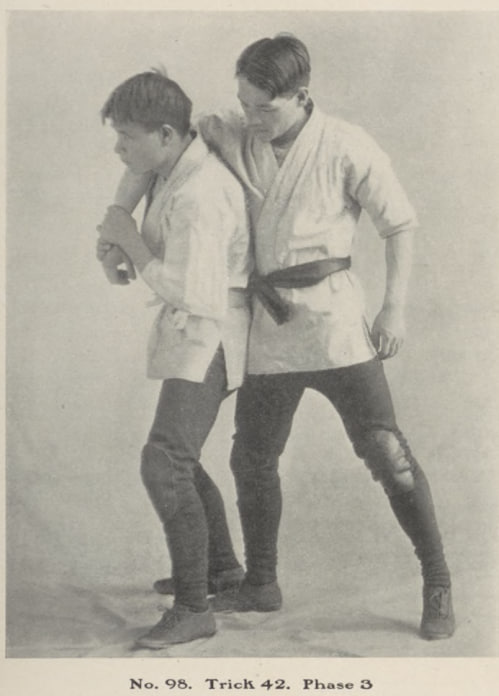
Your opponent now swings, bringing your captured arm over his shoulder as if he intended to throw you by the trick known to American wrestlers as the "flying mare." This "flying mare" is worthless as a jiu-jitsu trick. The Japanese employ it only as a ruse. It will be seen, in illustration No. 98, that your opponent has seized your captured hand in such a way that he can bend it over on the wrist to cause pain.
Trick 42. Phase 4
(No illustration.) Your opponent pretends to try to throw you over his shoulder. You drag back and bend back in an effort to throw him. Just as you do so your adversary suddenly slips his head out from under your arm, and, still holding your captured hand, steals back of you. As soon as he is at your rear he applies a crushing flexion that bends your captured hand over upon your wrist. At the same time he extends his right leg, wedging his right foot against the back of your right foot. With your right foot thus wedged, and with his flexing grip on your right hand, he throws you easily, and, if he does so roughly, breaks your right wrist and elbow.
Trick 43 — Hip Bone Press Counter 🔤 Malayalam
No. 99. Trick 43. Phase 1
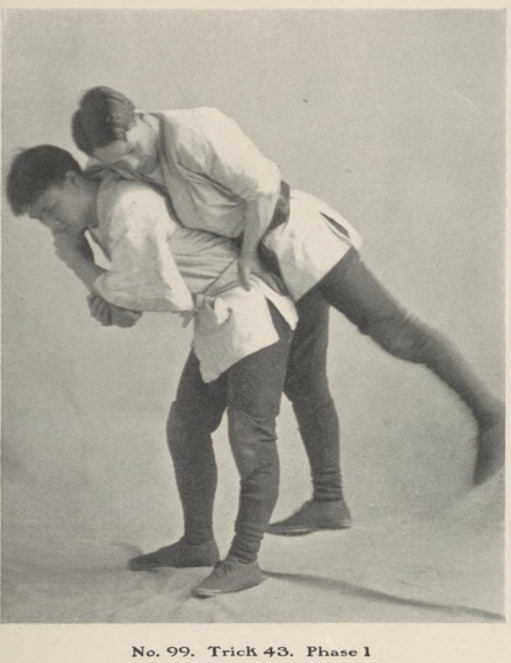
Suppose your opponent actually tries to throw you by the "flying mare"—do not resist by dragging back. If you do, your opponent will use upon you the foregoing trick. This warning is highly important! As he attempts to pull you over his shoulder, leap up as if to go over in the way that he wishes you to do. But press the ball of your left thumb forcibly into the flesh at the top of his left hip bone, and you will cause him such pain that he is weakened, and cannot throw you.
No. 100. Trick 43. Phase 2
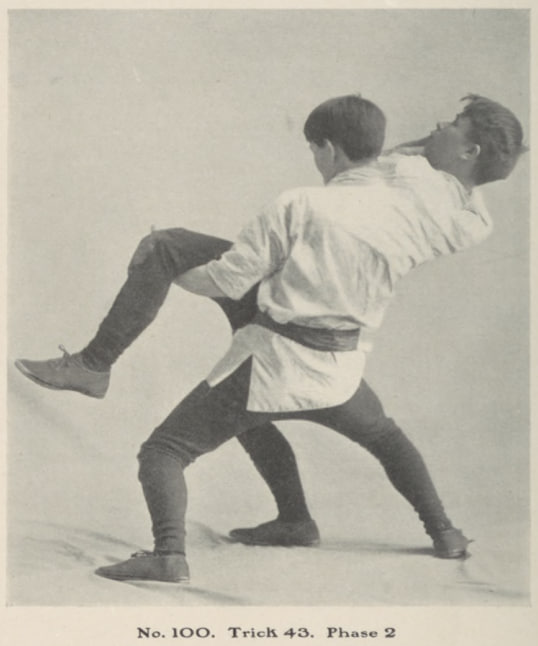
As your opponent weakens and lets your feet come back to the ground, step your left foot outside and forward of his left foot. At the same instant drag your captured right arm back, and with your left hand seize him under his left knee, thus lifting him and throwing your victim. It may be necessary, now, to employ Trick 44.
Trick 44 — Leg Wrap Lapel Choke 🔤 Malayalam
No. 101. Trick 44. Phase 1
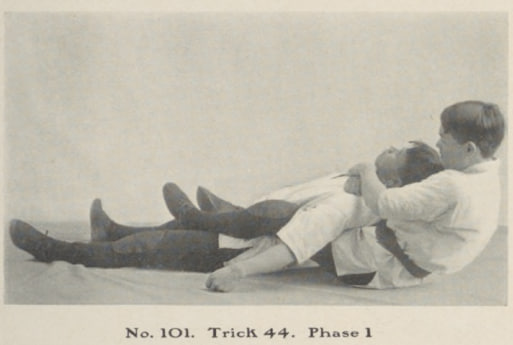
As you fall by means of the foregoing trick, wrap your legs crushingly around your victim's waist line. Take hold of his coat lapels with crossed hands and apply strangulation, as shown in illustration No. 101. At the same time, bending your head forward, push the upper portion of your chest against the back of your adversary's head, as shown.
Trick 45 — Head Stand Throw 🔤 Malayalam
No. 102. Trick 45. Phase 1
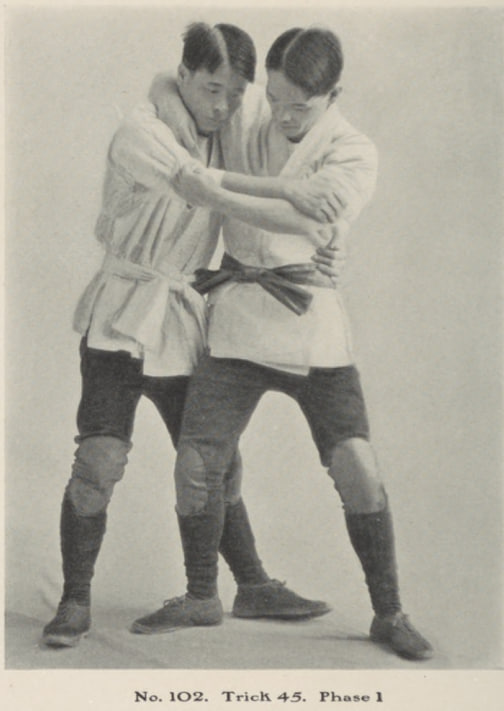
If your assailant seizes your left sleeve with his right hand and throws his left arm around your waist, then throw your right arm around his neck, and with your left hand seize him at his right elbow. In illustration No. 102 the white-belted assailant has placed his left leg back of his opponent's right leg with the intention of throwing the latter backward.
No. 103. Trick 45. Phase 2
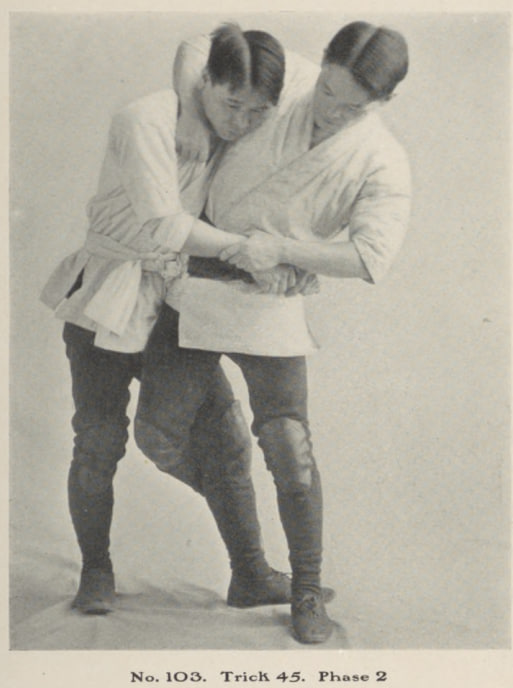
Your assailant will now take the best hold that seems open to him; he will seize your belt at your left with both of his hands. Your left hand should now slide down to a grip upon his right wrist. At the same time, in order to deceive him as to your intentions, wrap your right leg around his left leg, as shown in illustration No. 103.
No. 104. Trick 45. Phase 3
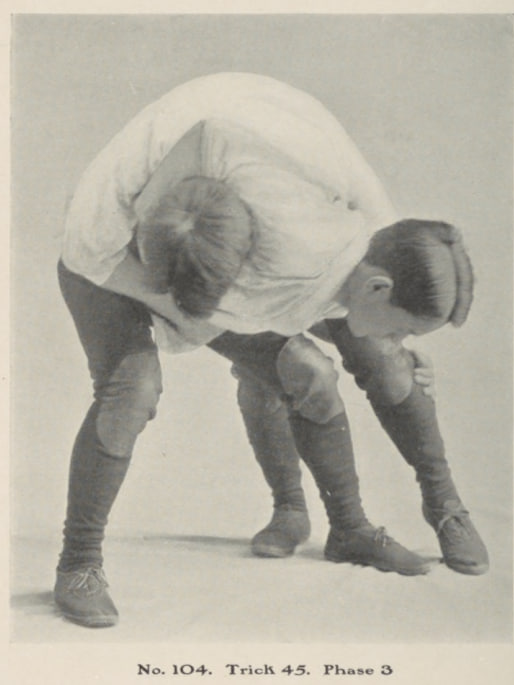
Now that your assailant is guarding against the grapple that you have taken on his left leg, release your right leg and step it quickly outside of his right leg, at the same time bringing your left leg between his legs, as shown in illustration No. 104. With your left hand seize the outside of his left knee.
No. 105. Trick 45. Phase 4
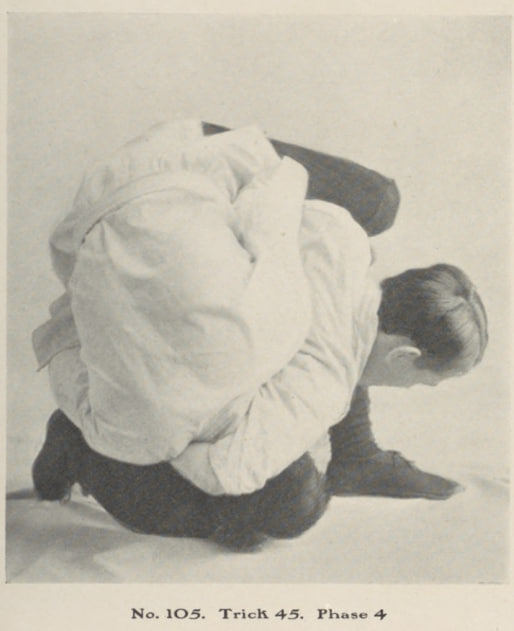
Sink quickly and forcibly to the right knee. This brings your victim over, standing on the top of his head. With your right arm pressing heavily against the back of his head, and your right knee pushing at the side of your victim's head, throw him over on his back.
No. 106. Trick 45. Phase 5
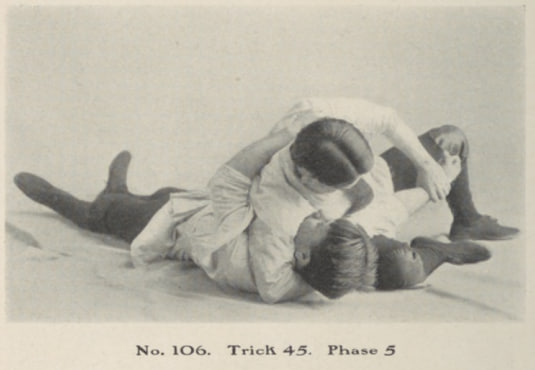
The fall is made as shown in illustration No. 106. Force your victim's right arm backward over your right knee, as if to break his arm, and continue this pressure until he surrenders.
Trick 46 — Belt Grip Backward Fall 🔤 Malayalam
No. 107. Trick 46. Phase 1
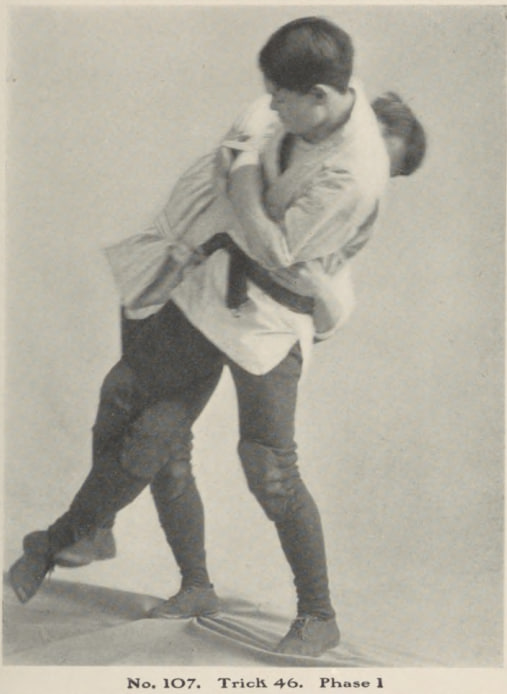
Here the assailant (in the white belt) has wrapped both arms around his adversary's waist, and has allowed his opponent (in the black belt) to secure a chancery hold. It is the intention of the man wearing the white belt to throw his opponent backward over his shoulder by means of Trick 38.
When attacked in this manner, release your right arm from its chancery hold, and with your right hand seize your opponent at his back strap or belt. Wrap your right leg around his left leg, forcing his foot up from the floor, as shown in illustration No. 107.
Bending your knees somewhat, and swaying to the right, throw yourself backward. Fall with your victim under you, and your right arm crushing his neck. In the Second Section many tricks will be explained, by the use of any one of which you will be able to dispose of your antagonist when you have made a throw like this one.
Trick 47 — V-Arm Leg Throw 🔤 Malayalam
No. 108. Trick 47. Phase 1
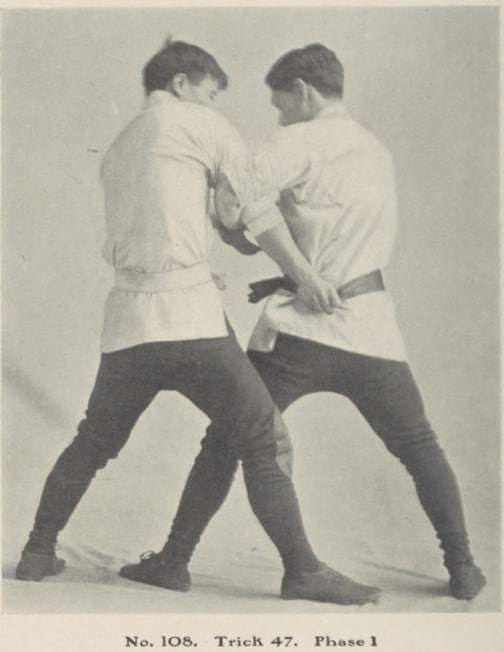
If your opponent attempts to throw you by the use of Trick 9, release your left arm from its hold around his waist, and throw your left arm around his right arm, as shown in illustration No. 108. This seizure with your left arm will require careful study before you can master it. Your arm is to be held so that it forms like a letter "V," with the fist up, and the base of this "V" is at the back of his upper arm just above the elbow. Now, with your right hand you seize your left wrist. It is not always necessary to employ your other hand to seize the wrist; in this you must be governed by the conditions.
No. 109. Trick 47. Phase 2
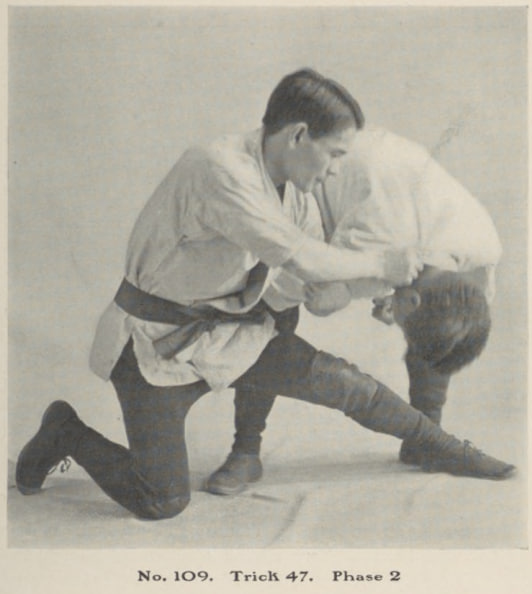
Like a flash you must fall to your right knee, and extend your left leg, rigid, in front of his left foot. With your left arm you have a pressure upon his right arm that can be applied forcibly. Swaying your body a little around to the left, exert this pressure quickly and throw your adversary over your left foot. This whole trick must be performed with the utmost rapidity. When your opponent is thus thrown you will find it necessary to employ Trick 48.
Trick 48 — V-Arm Elbow Break 🔤 Malayalam
No. 110. Trick 48. Phase 1
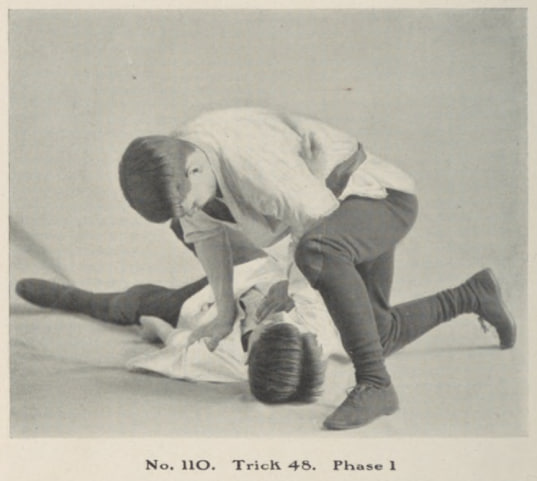
By use of the foregoing trick you threw your antagonist, as shown in illustration No. 110. Your left arm is still around his right in a "V." Wrap your left thumb, if possible, in his lapel, and press your left fingers against your victim's "Adam's apple" in order to strangle him. Wedge your left knee against the back of his right elbow, and apply a twisting pressure with your left arm on his right arm in a way that will break it if he does not promptly surrender. At the time of taking this hold bend over your victim, as shown in the illustration, and push your right hand against his left shoulder in order to prevent his turning.
Trick 49 — Thigh Grip Shoulder Throw 🔤 Malayalam
No. 111. Trick 49. Phase 1
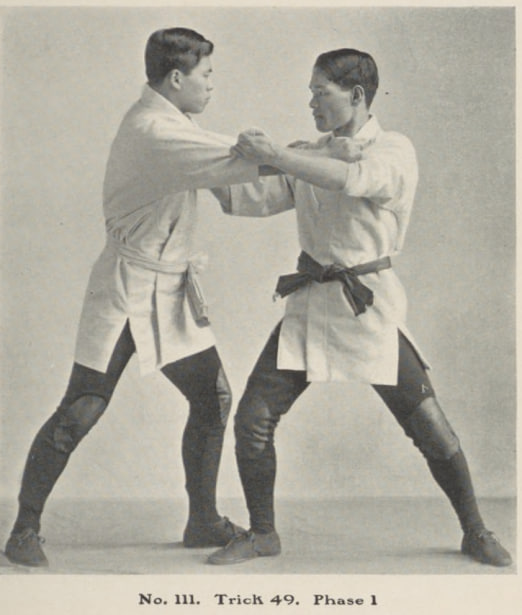
If your opponent, with his right hand, seizes your left lapel, and with his left hand your right shoulder, then take the hold shown in illustration No. 111, with your left hand wrapped in his right sleeve and your right hand seizing his right lapel. This latter is a bit of strategy, as, from your having seized his right lapel, your opponent thinks it to be your intention to throw him to his right.
No. 112. Trick 49. Phase 2
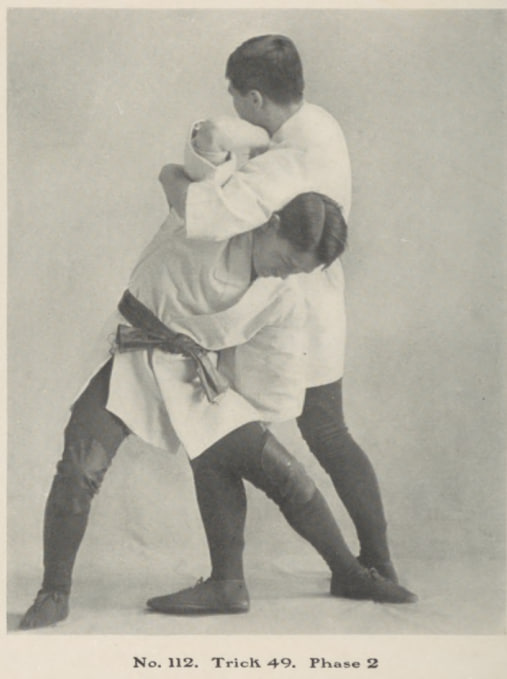
Make a quick move to your opponent's left, thrusting your left leg back of his left leg, as shown in illustration No. 112. At the same time force your head under your adversary's left arm, and with your left hand seize him at the inside of his left thigh. Now, instantly, shift so as to bring your left leg in front of your opponent's left leg, and your left foot between his two feet. This is done in order to deceive your adversary, who, when your leg was back of his, had a chance to throw you backward.
No. 113. Trick 49. Phase 3
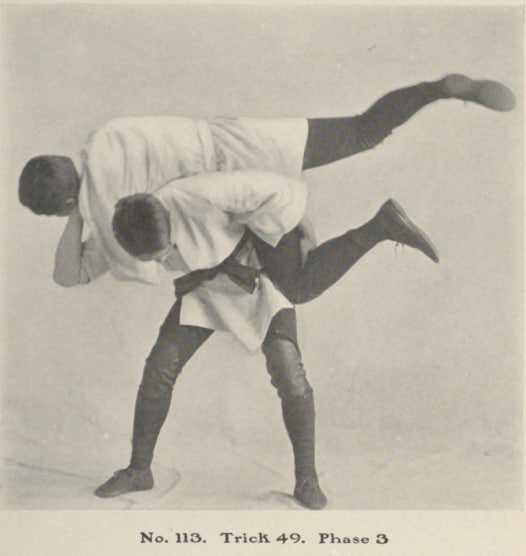
Bend quickly, and shifting to the hold shown opposite, throw your victim over your shoulder. Then employ one of the tricks that you will learn in the first part of the Second Section.
Trick 50 — Leg Lift Backward Throw 🔤 Malayalam
No. 114. Trick 50. Phase 1
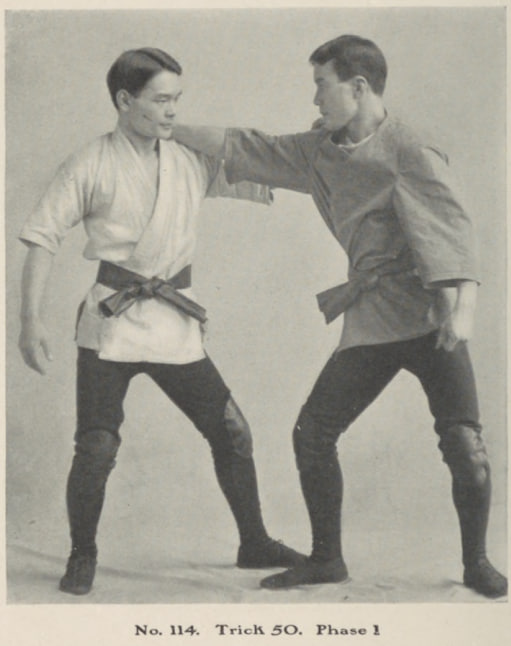
Here your opponent has seized you with his right hand around your neck, and your left hand has seized him at his right shoulder. If he attempts to seize you with his left hand, strike away that hand by hitting him sharply at the edge of his wrist with the little finger edge of your right hand.
No. 115. Trick 50. Phase 2
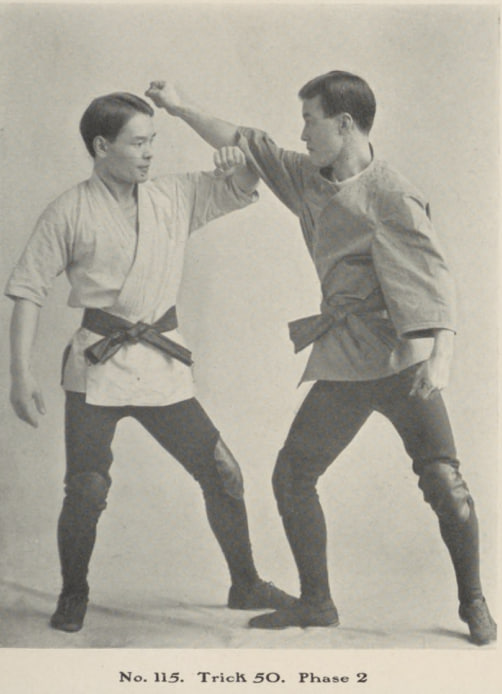
No appreciable time can elapse between Phase 2 and Phase 3. Both must be performed like lightning. Take off your opponent's right arm by striking his "funny-bone" with your left fist.
No. 116. Trick 50. Phase 3
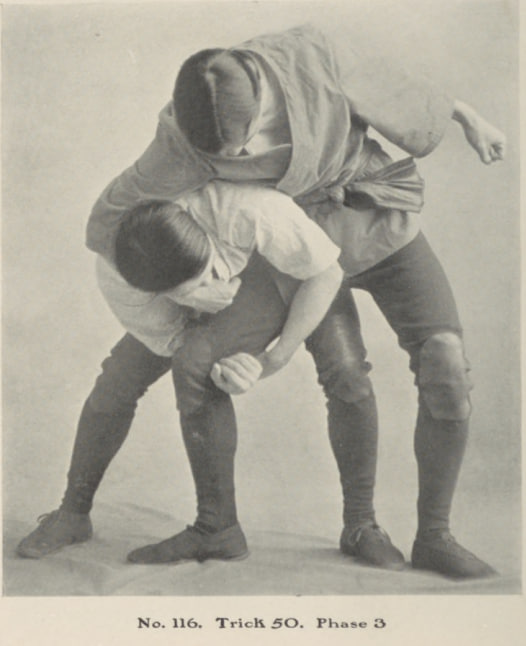
With a sudden turn, throw your left leg back of him and between his two legs, as shown in illustration No. 116. At the same time throw right forearm back of his right leg, and with your left hand seize your own right wrist.
No. 117. Trick 50. Phase 4
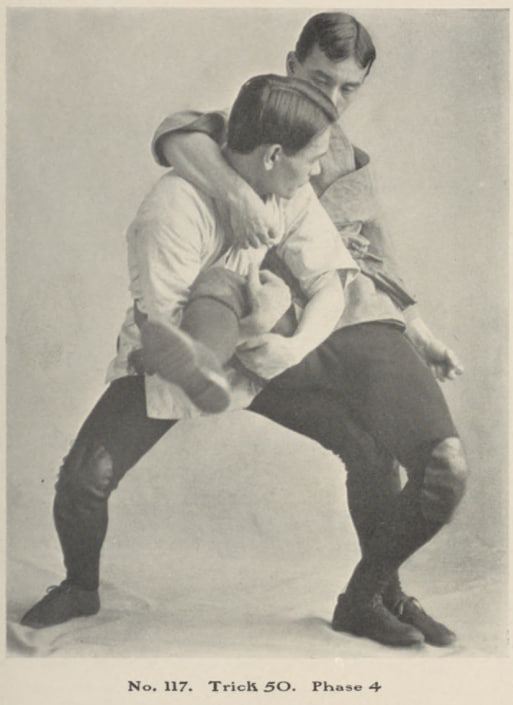
Now, straighten yourself up swiftly, dragging your victim's right leg up with you. At the same instant press your left elbow strongly against your victim's stomach, and thrust your left foot around outside of his left foot, wedging the latter. Now, throw yourself backward, carrying your victim over so that he falls under you. In order to complete the subjugation of your victim, employ Trick 51.
Trick 51 — Foot and Knee Twist 🔤 Malayalam
No. 118. Trick 51. Phase 1
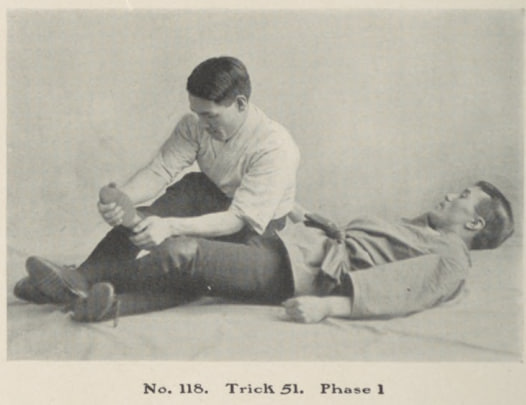
As soon as your victim is down, wrap your feet around his left foot, as shown in illustration No. 118. Seize your antagonist's right foot just as is shown in the illustration. Bend his knee by pressing your chest against it, and this, aided by twisting the foot, twists his knee as well. The ankle can be broken by this twisting.
(This trick is used in wrestling, not against a boxer. But if the victim were to use his idle hand to strike the victor in the neck, the agony caused by having his foot and knee twisted would weaken him so that he would quickly desist from attempting blows.)
Trick 52 — Lapel Choke Swing Throw 🔤 Malayalam
No. 119. Trick 52. Phase 1
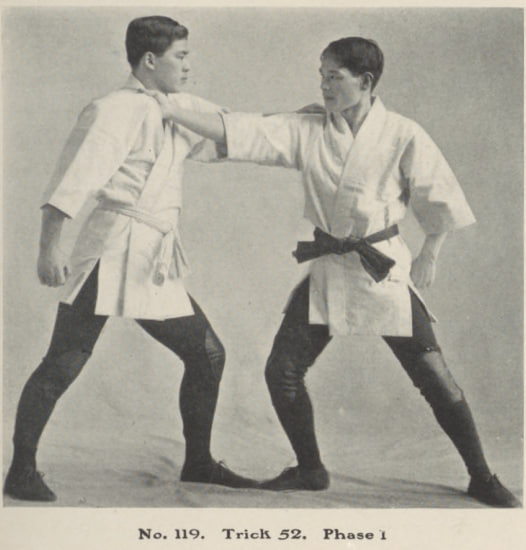
With the right hand seize your opponent's right lapel as if you intended to choke him.
No. 120. Trick 52. Phase 2
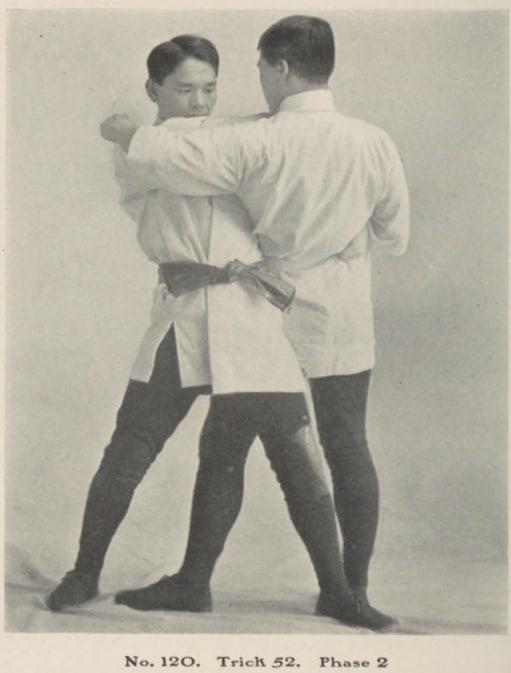
Now, close in with your adversary, and, with your left hand, seize his left coat lapel lower down than you have taken the right lapel. You are now in position to choke your opponent. While taking the hold you have thrown your left leg well past your opponent's, as shown in illustration No. 120.
No. 121. Trick 52. Phase 3
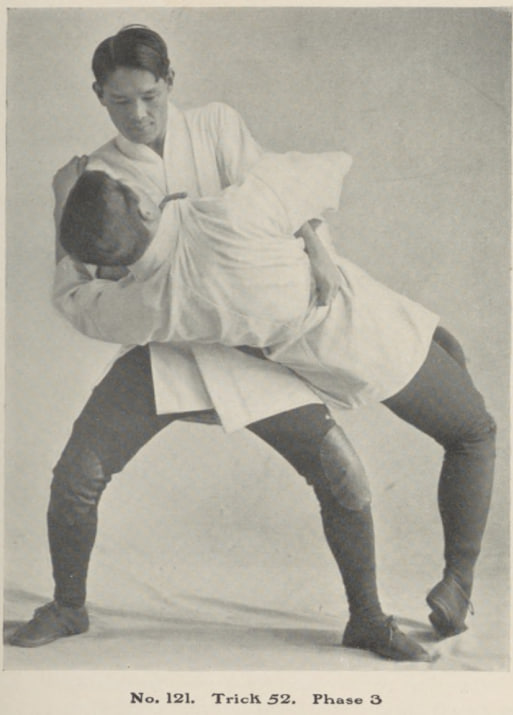
Quickly swing sideways and let go of the lapel hold with your left hand, seizing, instead, at your opponent's right side, as shown in illustration No. 121. Throw him over in front of you, the right hand all the while retaining the choking hold with which you began. Subdue your victim by the use of one of the tricks in the first part of the Second Section.
Trick 53 — Belt and Lapel Shoulder Throw 🔤 Malayalam
No. 122. Trick 53. Phase 1
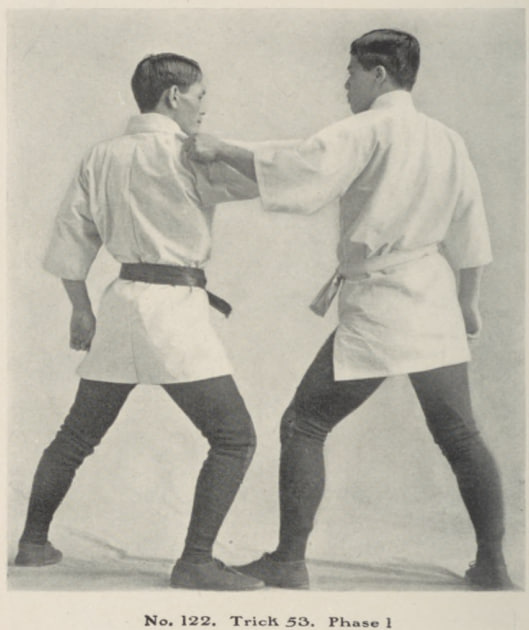
When your antagonist seizes you, as shown in illustration No. 122, with his left hand at the back of your right shoulder, employ your right hand in quickly seizing his right lapel. Do not allow him to seize you with his right hand. (If an assailant attempts to seize you at the elbow, strike his hand away with your elbow just as he seizes. Should he attempt to seize your arm higher up, strike the edge of his wrist smartly with the edge of your hand.)
No. 123. Trick 53. Phase 2
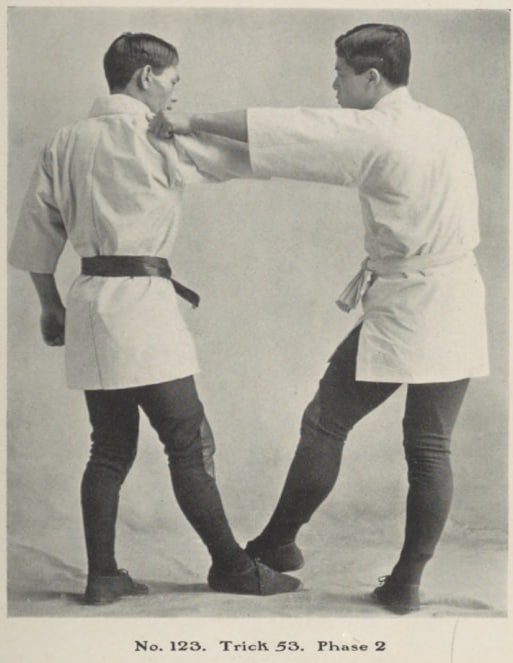
Draw back, straightening your right leg and pulling your adversary slightly toward you. This move leads him to think that he has an opportunity, and as he is pulled toward you he slips his left foot outside your right, and prepares to throw you to your right. Quickly shift your right foot outside his left.
No. 124. Trick 53. Phase 3
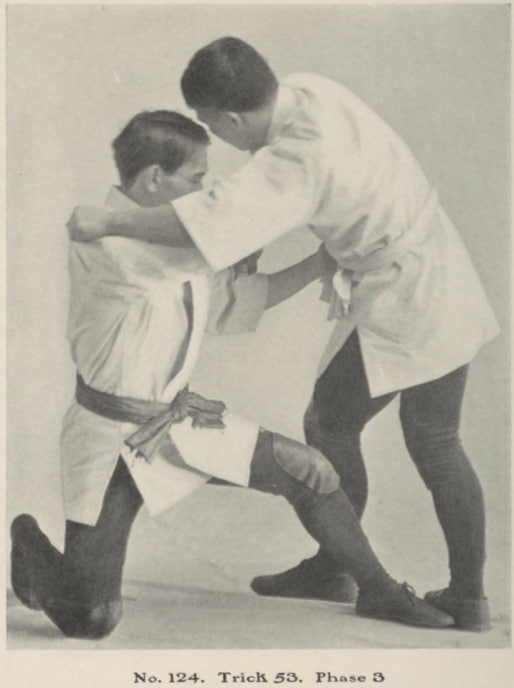
As you close in and seize at your opponent's belt, sink to your right knee and wedge your left knee against the outside of your adversary's left knee.
No. 125. Trick 53. Phase 4
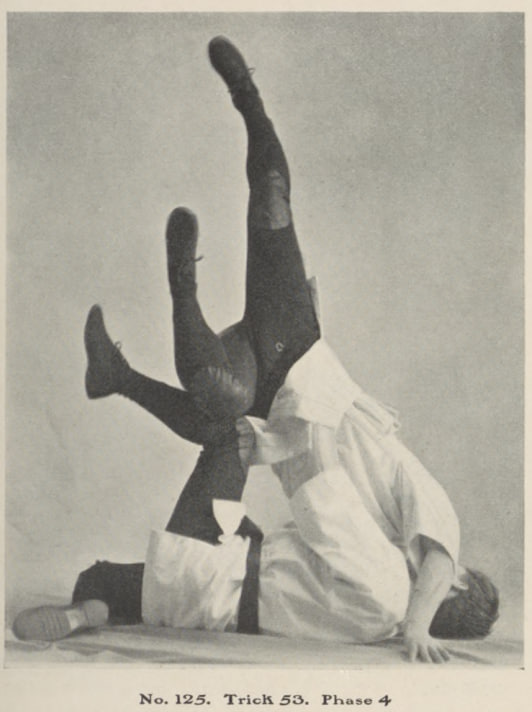
This work must be done swiftly and forcefully. With your right hand still at your adversary's right lapel, pull toward you and down, and with your left hand at his right belt, yank strongly up. Throw yourself forward on your right shoulder, and with your left shoulder push your victim's left knee up. Throw him over your left shoulder. Now, follow up your advantage by using Trick 54.
Trick 54 — Lapel and Stomach Submission 🔤 Malayalam
No. 126. Trick 54. Phase 1
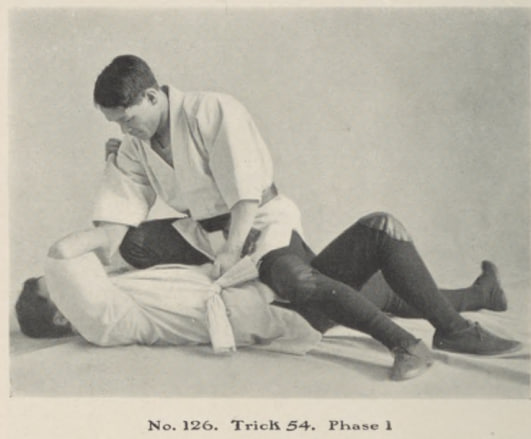
When the throw has been made by means of the foregoing trick, retain the original hold at your victim's lapel and belt. With your right hand pull the victim's lapel over his throat so that with the second knuckles of your first and second fingers you can press severely against his "Adam's apple."
At the same time, with your left hand in the victim's belt, work upward against his stomach with the knuckles at the bases of the phalanges.
This motion is difficult of description in words. It is a half-digging, half-churning motion. Roughly knead the victim's stomach and force it upward out of place. This latter trick can be made to cause intense discomfort to the victim. If you were to oppress him only by choking him with your right hand, the victim might escape, but with the stomach attack added he is helpless and must surrender.
Trick 55 — Neck Wrap Knee Trip 🔤 Malayalam
No. 127. Trick 55. Phase 1
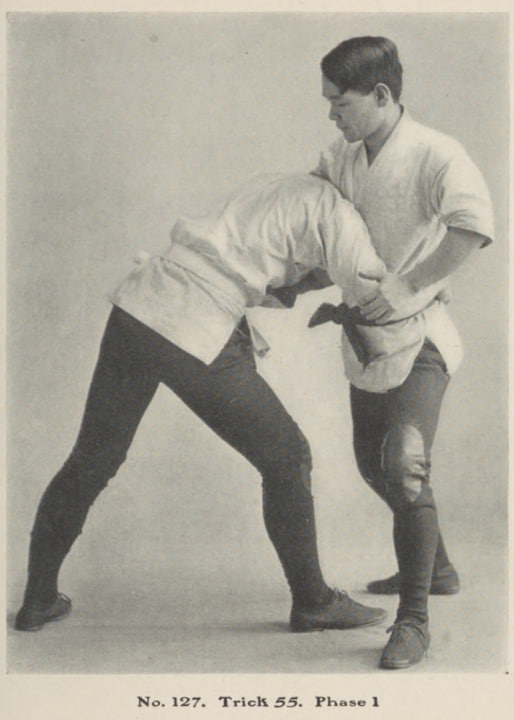
When your opponent seizes you around the waist, throw your right arm around him and with your left hand seize his right elbow. Now, quickly throw off your opponent's left arm with your right elbow, and throw your right arm around his neck, reaching over and completing your hold by clutching his right lapel with your right hand.
No. 128. Trick 55. Phase 2
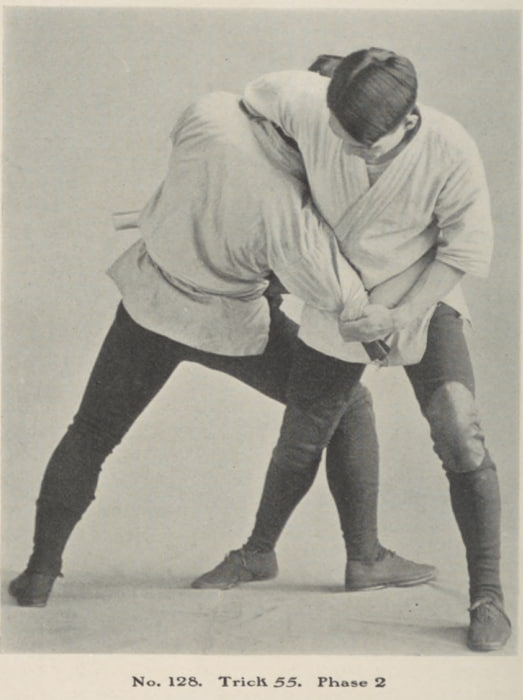
With the back of your right knee kick at the back of your opponent's right knee, forcing him to sit down backward.
No. 129. Trick 55. Phase 3
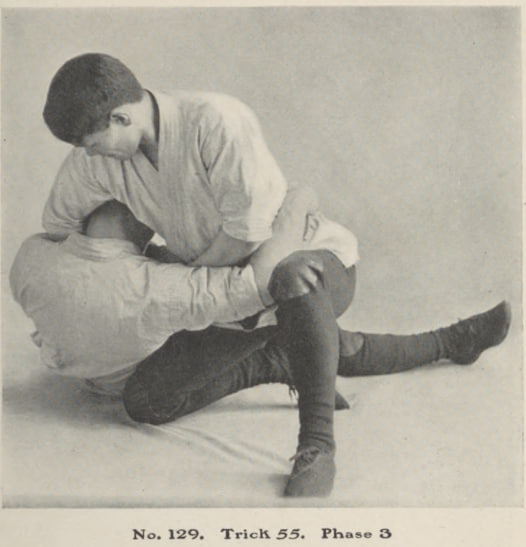
Your victim will fall as shown in illustration No. 129. Your right arm is already around his neck. Now, seize your own right wrist with your left hand, at the same time throwing yourself to a kneeling position at your victim's right. The victim's neck is just under your shoulder.
Now, tighten up the "V" that you have made with your right arm, and throw your weight upon the back of your victim's neck, at the same time strangling him by the pressure of your forearm at the front of his neck.
This combination of weight and pressure, if carried too far, will break the victim's neck.
Trick 56 — Crossed Wrist Throw 🔤 Malayalam
No. 130. Trick 56. Phase 1
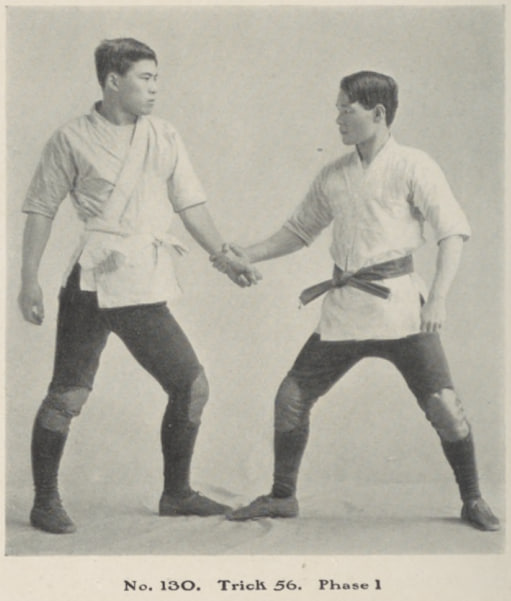
When your assailant seizes your wrist, it is easy to break his hold. Clench your captured fist with the thumb uppermost, and flex the fist up toward your shoulder, keeping the thumb uppermost throughout. In this way you can always break an opponent's hold on your wrist. As you break the hold, seize his wrist instead.
No. 131. Trick 56. Phase 2
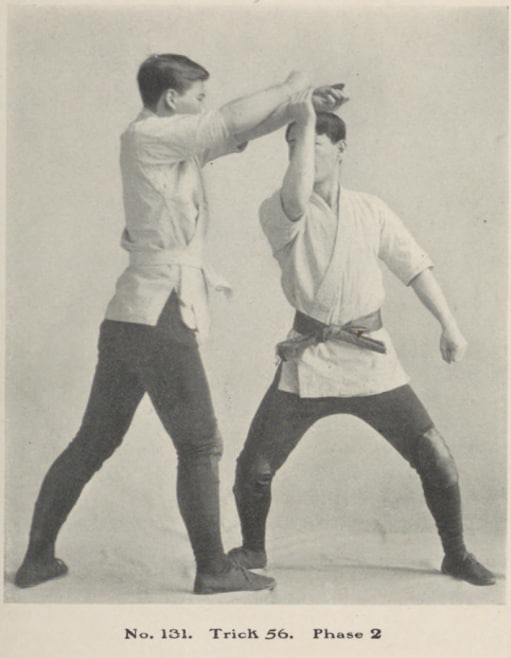
Like a flash your adversary tries to strike you in the face with his free right hand. Push his captured left fist under his right fist.
No. 132. Trick 56. Phase 3
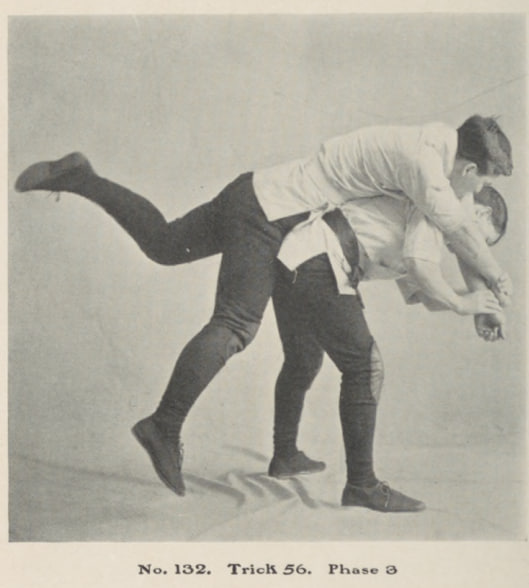
Seize your adversary's crossed wrists with both your hands, swing around, bringing both of his arms over your right shoulder, and throw him.
No. 133. Trick 56. Phase 4
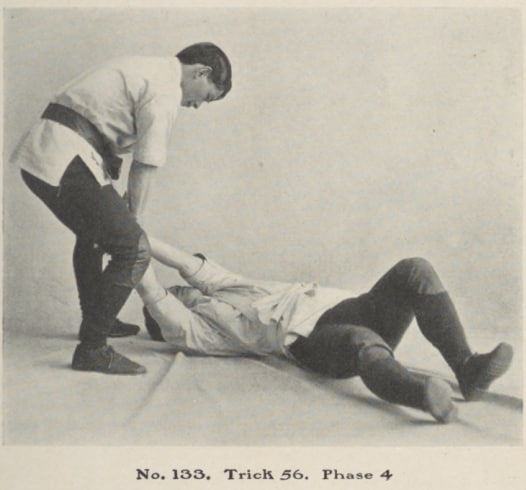
As the man is thrown, his position and yours will be as shown in illustration No. 133. While the victim's hands are still crossed, seize either one of his thumbs, and now employ Trick 57.
Trick 57 — Thumb Twist Arm Break 🔤 Malayalam
No. 134. Trick 57. Phase 1
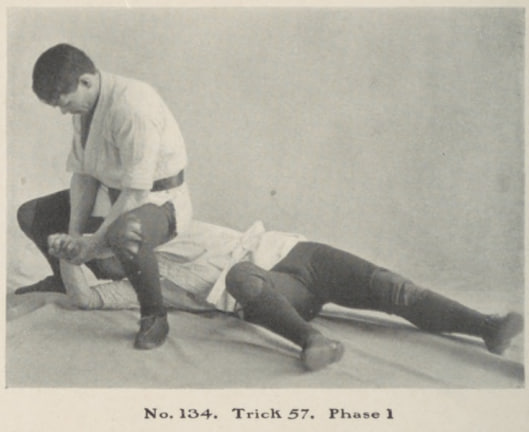
Here the assailant has seized the right thumb, and has twisted it outward and backward. So far, the hold on both of the victim's hands has been retained. Now, suddenly release the hold on the right thumb, seizing the victim's left wrist with both of your hands. As you do so, suddenly place your left foot at his left arm, and sit down quickly on his left shoulder. Press his left elbow with your left knee and pull his left arm upward. It is possible, in this way, to break the victim's captured arm.
Trick 58 — Double Wrist Release Throw 🔤 Malayalam
No. 135. Trick 58. Phase 1
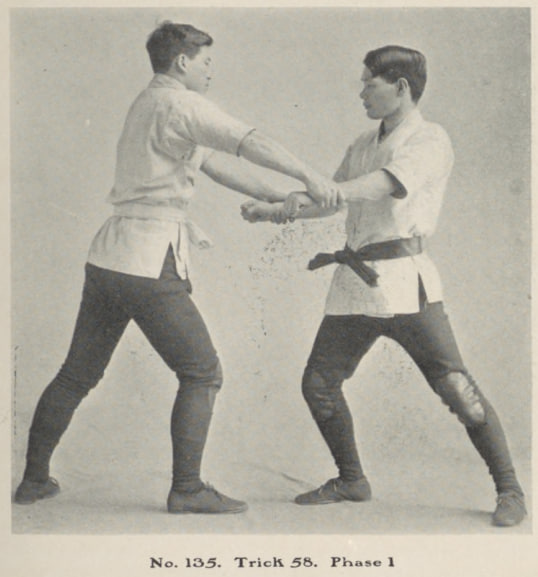
Here your assailant has seized you by both wrists.
No. 136. Trick 58. Phase 2
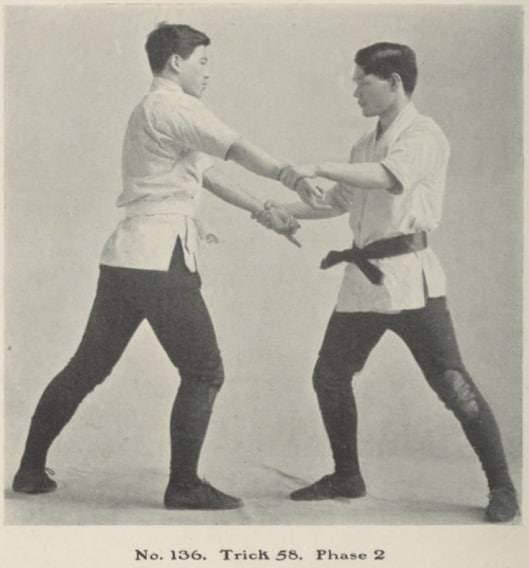
If your opponent is very strong, it will be necessary to push strongly down and forward with your captured hands, forcing him to extend his arms straight and rigid, at the same time making him bend backward a little. Now, with your thumbs uppermost, flex your fists and pull your wrists out of his grasp. Then instantly seize his wrists.
No. 137. Trick 58. Phase 3
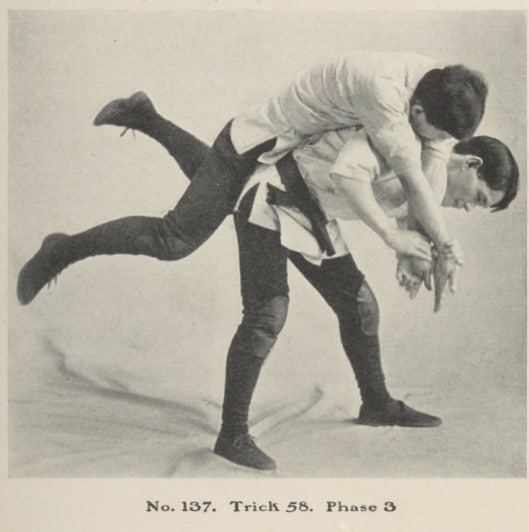
Crossing your adversary's wrists, pull both of his arms over your shoulder and throw him.
Trick 59 — Belt Grip Knee Throw 🔤 Malayalam
No. 138. Trick 59. Phase 1
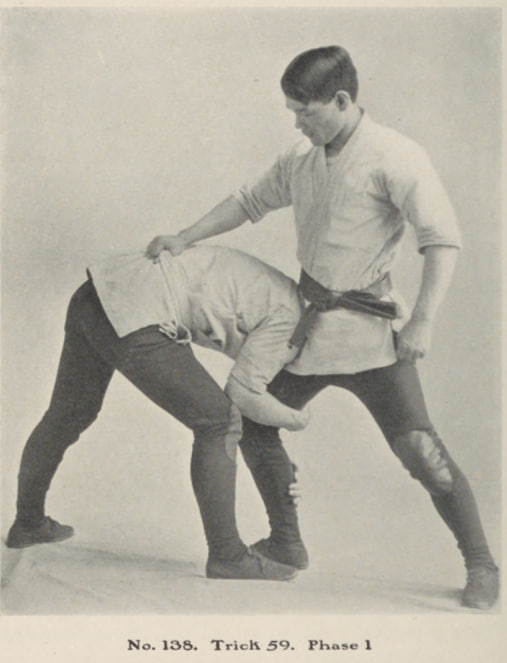
When your opponent bends forward and wraps both his arms around one of your legs, seize his belt at the back, as shown in illustration No. 138.
No. 139. Trick 59. Phase 2
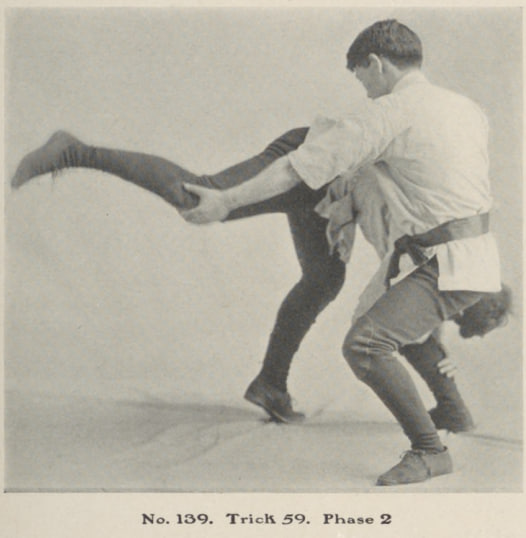
Bring your left foot one step forward, and catch at your adversary's right knee with your left hand.
No. 140. Trick 59. Phase 3
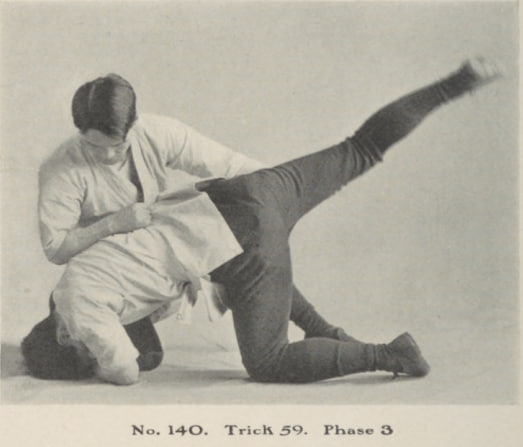
Like a flash throw yourself on the knee that has been seized. At the same time push up on the victim's knee that you have seized, and throw him. Your victim, in a serious contest, lands upon his face, badly damaging it, and as you throw him over upon his back his right elbow is broken.
Trick 60 — Neck and Leg Overhead Throw 🔤 Malayalam
No. 141. Trick 60. Phase 1
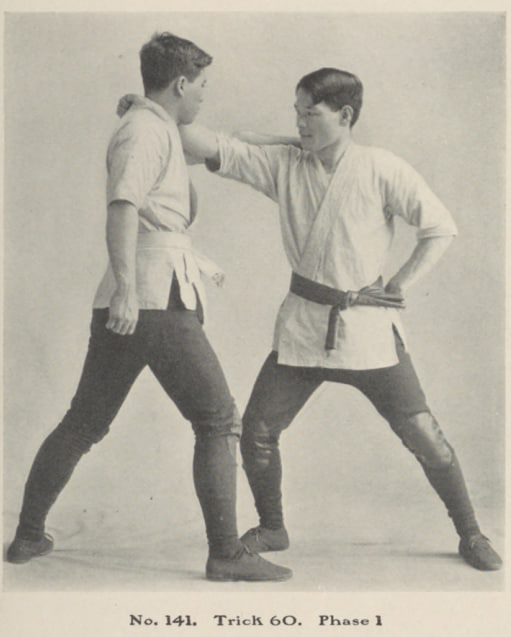
When your opponent has you in hold at your shoulder, thrust your arm inside of his and seize him at the back of the neck.
No. 142. Trick 60. Phase 2
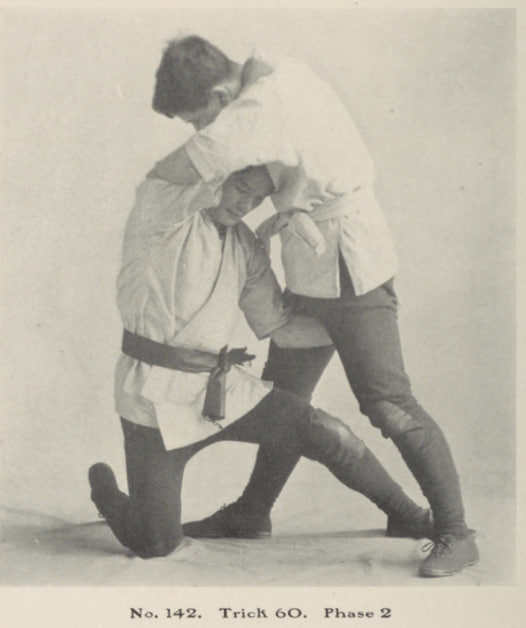
With your right hand still at the back of your adversary's neck, thrust your left arm between his legs, seizing him at the back of the leg. Swiftly drop to your right knee, push the top of your head against his chest, and extend your left leg between his two legs, wedging your left foot at the back of his left heel. If you do not thus wedge your opponent's left foot he will find a chance to get out of the trap that you have set for him.
No. 143. Trick 60. Phase 3
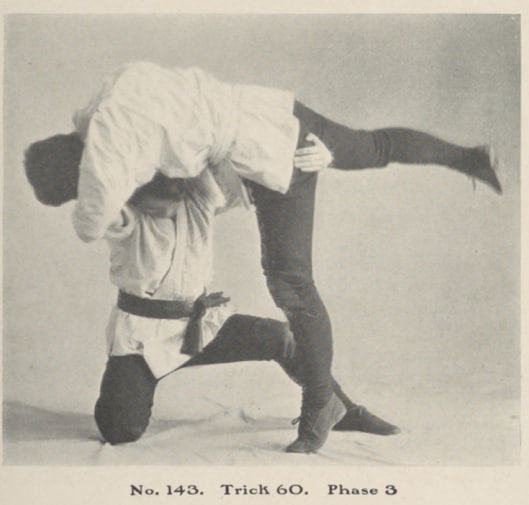
Bend forward, pulling on your victim's collar and on his left leg, as shown in illustration No. 143. Now throw your man over in front of you onto his back, his feet describing the arc of a circle as he goes over.